Planning
Indianapolis Wedding Catering: Vendors, Pricing & What to Know
 By Sarah Conrad Updated Sep 2, 2026
 Wedding catering in Indianapolis runs on roughly 63 active caterers across the metro (WeddingWire, 2026), five service styles worth understanding, two government permits that someone has to file, and one decision that anchors the rest of your reception planning. This guide walks the whole stack the way I walk couples through it on a venue tour, sorted by what actually moves the budget and the timeline.
I have hosted hundreds of conversations with couples at 24 Shelby, our 1898 bottling-house venue in downtown Indianapolis, and catering is the question that surfaces fastest after the venue itself. Sometimes before the venue. The math is honest about why. Catering, cake, and drinks together account for about 24% of the average wedding budget (The Knot, 2026), the biggest line item after the venue, and the one that scales most directly with guest count.
How Much Does Wedding Catering Cost in Indianapolis?
Wedding catering pricing in Indianapolis is built on per-person totals, and per-person totals are built on five variables: guest count, service style, menu complexity, date, and how much front-of-house labor the format demands. The Indianapolis market sits a little below national averages on average wedding spend, but the variance inside that average is wide. The same 150-guest reception can quote at very different per-person numbers from two reputable caterers on the same Saturday.
The Indianapolis-Carmel-Anderson metro is projected at 11,694 weddings for 2025, with an average guest count in the 150 to 160 range (The Wedding Report, 2025). Larger weddings benefit from economies of scale on catering. The per-person rate usually drops as guest counts climb past 100, then plateaus. Smaller weddings (50 to 80 guests) can actually run higher per person because the staffing minimums do not scale down as cleanly.
Here is the part most couples miss. The headline per-person price is rarely the real number. Service charges, gratuity, sales tax, and add-ons (cake-cutting, late-night snacks, vendor meals, bar staffing if your caterer handles bar) stack on top. For the full breakdown of where venue and catering costs hide before you sign, the hidden costs of wedding venues guide walks every line item.
According to Sarah Conrad, Managing Partner at 24 Shelby, “Catering is the line item that moves the most with guest count, and the line item couples underestimate the longest. Ask every caterer for one all-in per-person number that includes food, service, tax, and tip. The quote that lists those four separately is hiding something the others aren’t.”
What Catering Styles Work Best for an Indianapolis Wedding?
The five catering styles that matter for an Indianapolis wedding are plated, buffet, family-style, food stations, and cocktail-style heavy hors d’oeuvres. Each one shifts staffing, timing, dietary flexibility, and the room’s energy in different directions. The style you pick should match the venue layout, the guest count, and the kind of reception you actually want, not the style your favorite caterer happens to specialize in.
| Style | Best for | Staffing intensity | Timing |
|---|---|---|---|
| Plated dinner | Formal receptions, 100 to 250 guests, single-room venues | High (servers per table) | 75 to 90 minutes for a 3-course dinner |
| Buffet | Large weddings (150+), dietary variety, value-conscious budgets | Low to medium | 45 to 60 minutes for a full line |
| Family-style | Mid-size weddings (60 to 150), warmer guest energy, long farm tables | Medium | 60 to 75 minutes |
| Food stations | Cocktail-format receptions, venues with multiple rooms, dietary-heavy guest lists | Medium to high (chef-attended) | Flowing over 2 to 3 hours |
| Cocktail-style hors d’oeuvres | Smaller weddings, late-evening start times, no seated dinner | Medium | Flowing over 2 to 4 hours |
A few honest notes on which Indianapolis venues fit which style.
Plated dinners read most formal. They look the cleanest on a tablescape because the plate is part of the design. They also require the most front-of-house labor and the tightest dietary count, because every meal is pre-counted by entree the day before. Plated works beautifully in single-room downtown venues with strong table layouts, like 24 Shelby’s Edison Room.
Buffets handle scale and dietary variety better than any other style. A well-built buffet line covers vegan, vegetarian, gluten-free, and the protein-loving uncle in the same trip down the line. The catch is the line itself. Plan for two service stations or a double-sided buffet at any wedding over 120 guests, or you create a 30-minute bottleneck nobody enjoys.
Family-style is the format the wedding industry has rediscovered. Long farm tables, shared platters, food that looks like it belongs at a dinner party. It runs warmer than a buffet and softer than plated. The cost sits between the two. The staffing is closer to plated, because every platter still has to be staged, served, and cleared.
Food stations are the format I see couples consider most often at 24 Shelby and pick most often when the venue has multiple rooms. We can stage a charcuterie and salad station in the Libations Lounge, a chef-attended carving station in the Edison Room, and a late-night taco bar by the Prohibition Patio garage doors. Guests flow between rooms. The energy never stalls.
Cocktail-style receptions skip the seated meal entirely. They work for smaller weddings (under 80 guests) or for evening starts where most guests have eaten beforehand. Done well, they feel like the best cocktail party a couple has ever thrown. Done poorly, guests leave hungry and the night ends early.
For a fuller view of how catering interacts with venue layout and reception flow, the Indianapolis wedding reception planning guide walks the floor plan side of the decision.
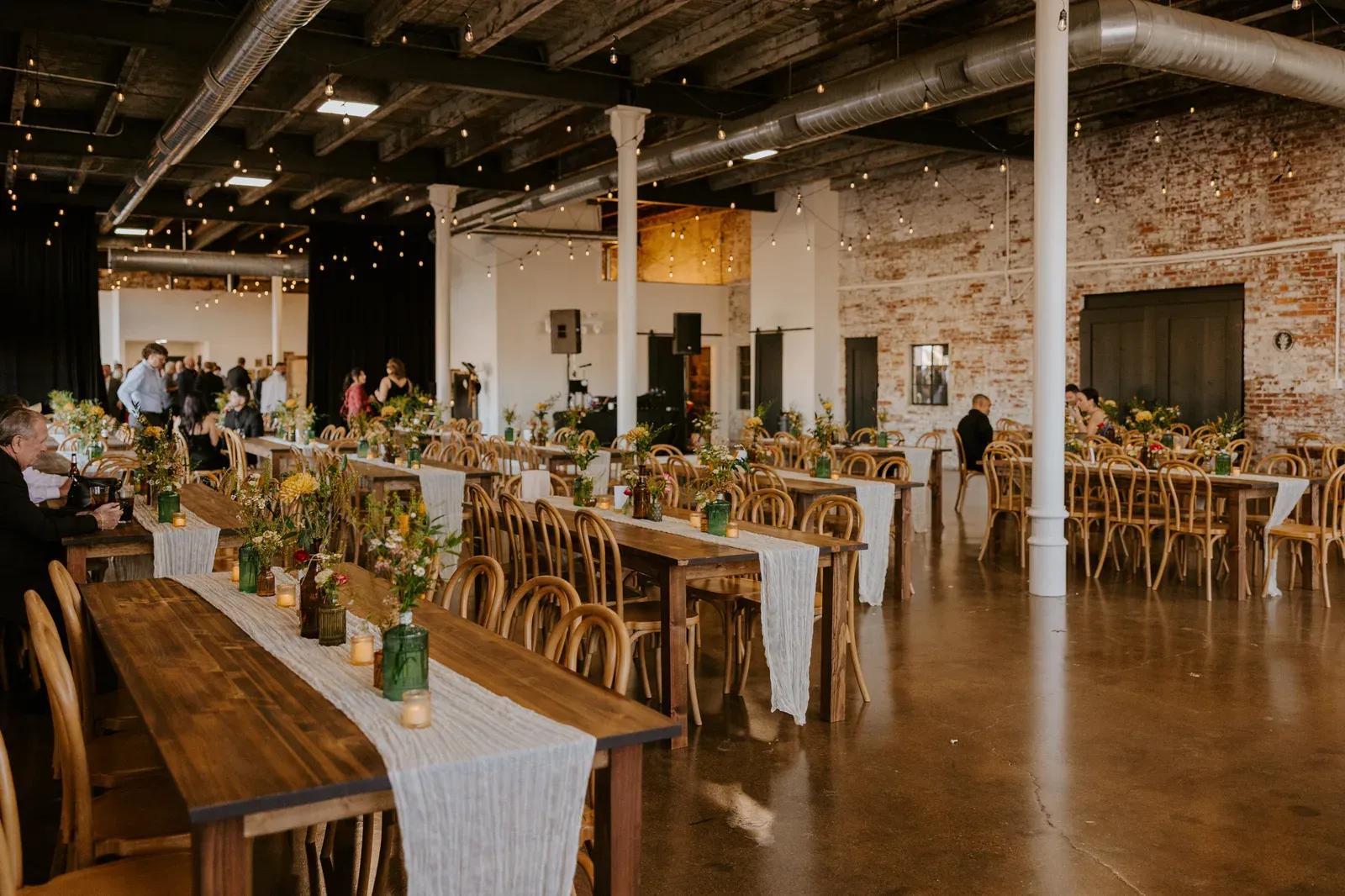 Photo: Clay House Photography
Which Indianapolis Wedding Caterers Should I Consider?
Indianapolis has roughly 63 active wedding caterers in the WeddingWire directory (WeddingWire, 2026), and the top of that list breaks down into three buckets: high-volume full-service shops that cater weddings every weekend in season, boutique chef-driven kitchens that cap how many they accept each year, and venue-attached caterers that double as event-space operators. Knowing which bucket a caterer sits in matters more than the cuisine on their menu, because the bucket decides the experience.
Here is the short list I recommend most often, with what each one does best.
1. Sweet and Savory Catering
A woman-led, scratch-kitchen caterer led by Executive Chef Melissa Mudd and Chef Shawn Mudd at 4340 W. 96th Street, Sweet and Savory Catering has been quietly turning out some of the cleanest plated dinners in the city for two decades. Their menu leans modern American with global influences, sourced from Indiana farms and cheesemakers. They run plated, chef-attended stations, and buffet, and they offer dedicated wedding tastings before booking. They are a boutique kitchen by design, so they book out fast for peak-season Saturdays. Best for: couples who want a chef-driven menu, dietary-heavy guest lists, and a caterer that treats every wedding as the only one on the calendar that day.
2. Sweet Escape Cake Company
Founder Amy McCorkle started Sweet Escape in her home kitchen before opening the South Meridian Street storefront. They are a desserts-only shop, which means they pair cleanly with whichever caterer handles dinner. Custom wedding cakes, grooms’ cakes, cupcakes, cake pops, dessert tables, shower favors. They are a preferred dessert vendor at Hotel Carmichael, Bash Indianapolis, and at 24 Shelby. Best for: the cake and dessert table, full stop. Book them alongside a full-meal caterer, not instead of one.
3. Cafe Patachou Catering
Martha Hoover opened the original Cafe Patachou at 49th and Pennsylvania in 1989 and has been a six-time James Beard Award semifinalist for Outstanding Restaurateur (Eater, 2022). Patachou’s catering arm is built around drop-off and pickup catering with private dining rooms at Patachou at the Stutz and Patachou Nickel Plate. Best for: rehearsal brunches, day-after farewell brunches, bridal showers, and welcome-bag breakfasts. Not the format for a plated reception dinner.
4. Crystal Signature Events
Founded in 1977, Crystal Signature Events is one of the longest-running large caterers in Indianapolis. They own and operate three downtown venues (The Indiana Roof Ballroom, Crane Bay Event Center, The Heirloom at N.K. Hurst) and cater both at their own properties and off-premise. Cuisine is contemporary American with a strong cocktail program. Best for: larger formal weddings, couples who like the security of a long-established operation. Note that off-premise availability is more limited than caterers whose entire business is mobile.
5. Jonathan Byrd’s Catering
The Byrd family has been feeding central Indiana since 1952, and Jonathan Byrd’s runs one of the largest off-site wedding catering programs in the metro out of Carmel. They were the official catering company of the Indianapolis Colts and serve more than three million meals a year across catering, conference centers, Grand Park, and Camp Atterbury (Indianapolis Business Journal, 2016). Cuisine is classic American comfort with carved meats and home-style sides. Best for: larger weddings (125 guests and up), couples who want consistent crowd-pleasing menus over chef-driven experimentation.
6. Kahn’s Catering
Established in 1996, Kahn’s operates out of Allison Pointe and runs their own venue, The Montage. They are a preferred or exclusive caterer at the Scottish Rite Cathedral and at Newfields, and they cater off-premise across Indy. Cuisine is innovative modern American with a fine-dining sensibility. Best for: formal weddings, couples planning a structured reception with strong food service. Honest note: some couples find the menu less adventurous than chef-driven boutiques, so book Kahn’s if you want polish over surprise.
7. McAlister’s Deli Catering
A national fast-casual chain with multiple Indianapolis stores, McAlister’s Deli offers delivery-and-setup trays, box lunches, and breakfast through ezCater. They are not a full-service reception caterer, but they are the smartest budget pick for the supporting meals around the main event. Best for: rehearsal lunches, getting-ready food for the wedding party, day-after brunches.
A quick reality check on bar service. Crystal, Jonathan Byrd’s, and Kahn’s all offer in-house bar packages, and 24 Shelby couples should request food-only quotes from all three because our bar service is in-house and required. Sweet and Savory, Sweet Escape, Cafe Patachou, and McAlister’s are food-only or desserts-only, which means no overlap with our bar setup. Always ask the caterer in writing whether their quote includes bar, and align the answer with your venue’s bar policy.
 Photo: Photog Boss
How Do I Evaluate a Wedding Caterer in Indianapolis?
You evaluate a caterer by tasting their food, reading their contract, and watching how they answer questions you did not write down ahead of time. A good caterer wants you to push on every detail. A caterer that resists specifics in advance is going to resist them on the wedding day too. Treat the tasting as a working meeting, not a date night.
Here are the questions I tell every couple to ask on the first call, in roughly this order.
- What is your all-in per-person rate for our exact date, guest count, and service style? Ask for food, service, tax, and gratuity in one number. The quote that breaks all four apart is making the headline number look smaller than it is.
- What is the deposit, the payment schedule, and the cancellation policy? Wedding caterers usually take 25 to 50% to hold the date, with the balance due 7 to 14 days out. Read the cancellation terms before you sign.
- Who is the lead from your team on our wedding day, and are they staffing it themselves? Some caterers book the sales lead and then substitute a manager on the day. That can be fine, but you should know it before the wedding.
- What is your tasting policy? Most quality Indianapolis caterers offer tastings, sometimes complimentary for couples who have already signed, sometimes a small per-attendee fee. Confirm what the tasting includes, how many people, and how many menu items.
- How do you handle dietary restrictions, allergens, and kid meals? A caterer that volunteers a dietary process before you ask is a caterer that has done this before.
- What kitchen and prep space do you need at the venue? Ask if the venue’s food prep kitchen meets their setup. At 24 Shelby our prep kitchen handles every caterer we have hosted to date, but confirm in writing.
- What is your bar policy, and how does it square with our venue’s bar policy? This is the question most couples miss. At a venue with required in-house bar (us included), the caterer’s bar package usually has to come off the quote.
- Are you handling the Marion County temp food permit, and on what timeline? The answer should be yes, and the timeline should be days, not weeks.
For the broader tour-day checklist that covers caterer questions alongside venue, layout, and contract questions, see the 25 questions to ask on your Indianapolis wedding venue tour.
How Do I Handle Dietary Restrictions, Permits, and Alcohol?
You handle dietary restrictions, permits, and alcohol by getting all three in writing on your caterer contract and your venue contract before the wedding, not at the tasting and not at the rehearsal. Roughly 30 to 40% of wedding guests now report at least one dietary preference, restriction, or allergy (QuikRSVP, 2025), and about 22% of couples now intentionally include vegan dishes on the menu (WeddingWire, 2024). The percentages are not slowing down.
Dietary accommodation
Build dietary collection into your RSVP. Send the consolidated guest dietary list to your caterer at least three weeks before the wedding. Label every buffet and station dish on the day with the relevant allergens (gluten, dairy, nut, shellfish) and the vegan or vegetarian flag. For a guest with a serious allergy (peanut, tree nut, shellfish), confirm in writing how the caterer separates prep in the kitchen.
Marion County food permits
Marion County Public Health requires a temporary food establishment permit for any wedding involving food service outside a permanently licensed kitchen. In-county vendors need 48 hours notice. Out-of-county mobile units (food trucks, mobile pizza ovens, anything that drove in from outside Marion County) need 5 business days (Marion County Public Health, 2023). Your caterer files this. Confirm in writing they are doing it.
Indiana ATC alcohol permits
Indiana ATC requires a temporary beer and wine permit submitted at least 5 business days before any public event where alcohol is served (Indiana ATC, 2026). At 24 Shelby, our in-house bar handles every alcohol permit and every bartender. We do not allow outside bar service, and our bartenders carry the liquor licenses for our space. That is not us being rigid. That is the law of how alcohol service works at a public event venue in Marion County.
When your venue handles the bar, and when it does not
Indianapolis venues fall into three setups on bar service.
- Venue handles all bar service (24 Shelby and most downtown event venues). The caterer brings food only. The venue’s bartenders run alcohol. You buy bar packages from the venue.
- Caterer handles bar service (some all-inclusive caterers, some barn and farm venues with no in-house bar). The caterer’s quote includes alcohol and bar staffing. The caterer files the ATC permit.
- You bring your own alcohol (some dry venues and Airbnb-style rentals). You file the ATC permit, you hire a licensed bartender, you carry the liability. Most couples should avoid this setup unless they have a wedding planner managing it.
For the full picture on what venues bundle versus what they bill separately, the what’s included in a venue rental guide walks the comparison.
 Photo: Photog Boss
What About Tipping, Service Charges, and Vendor Meals?
Tipping, service charges, and vendor meals are the three line items that hide inside the catering total and account for most of the gap between the headline per-person rate and the all-in number couples actually pay. Each one is small. Together they routinely run 25 to 35% on top of the food cost. Knowing the math in advance prevents the rude surprise three weeks before the wedding.
Tipping
The Knot’s vendor tipping cheat sheet recommends 15 to 20% of the food and beverage total for catering staff and waitstaff (The Knot, 2026). Confirm whether your contract’s service charge already covers gratuity, because in many cases it does not. Some caterers build gratuity directly into the per-person rate. Some leave it for the couple to add cash on the day. Ask the question in writing. Get the answer in writing.
Service charges versus gratuity
Service charges are not tips. A service charge (commonly 20 to 25%) goes to the caterer to cover their staffing, overhead, and event-management costs. It is not paid out as a tip to the bartender or the carving-station chef, even though it shows up in the same neighborhood on your invoice. Gratuity is a separate line, paid to the staff on the day. Both can be expected. Sometimes one is wrapped into the other. Read the line items before the rehearsal dinner.
Vendor meals
Most catering contracts require you to feed every working vendor at the wedding (The Knot, 2025). The photographer, the DJ, the planner, the band, the videographer. They are working a full shift, often longer than yours, and they need a real meal. Couples hire an average of 13 vendors for a wedding (The Knot, 2026), and not all 13 are on site at dinner, but plan for 6 to 10 vendor meals on a typical wedding. Most caterers offer a discounted vendor-meal rate. Ask for it.
When Should I Book My Indianapolis Wedding Caterer?
Book your caterer 9 to 12 months out for a peak-season Saturday in Indianapolis, and 4 to 6 months out for off-season or weekday dates. The peak-season urgency is not marketing. About 76% of US weddings happen between May and October (The Knot, 2025), with October and June each accounting for around 16% of the annual total. The best Indianapolis caterers cap how many weddings they accept on a given Saturday. The chef-driven boutiques fill up first.
The booking order I tell couples to follow.
- Lock the venue. Catering pricing and policy depend on the venue’s setup, so you cannot fully evaluate a caterer without knowing whose kitchen they are walking into.
- Decide the service style. Plated, buffet, family-style, stations, or cocktail format. The style narrows the caterer shortlist faster than the cuisine does.
- Shortlist 3 to 5 caterers. Request the all-in per-person quote from each on the same date, guest count, and style. Apples to apples.
- Taste the top 2. Tastings are where the gap between “good on paper” and “good on the plate” shows up. Bring a notebook. Bring your other half. Take the leftovers home.
- Sign and pay the deposit. Once you sign, the caterer holds your date.
For the bigger-picture planning calendar that nests catering into the rest of the wedding timeline, the Indianapolis wedding cost guide and the all-inclusive wedding packages guide cover where catering sits in the budget and which Indianapolis venues bundle it versus charge it separately.
The Honest Take
Catering is the line item couples spend the most time researching and still get surprised by at the end. The fix is boring. Get one all-in per-person number from each caterer on the same date, the same guest count, and the same service style. Walk every quote through the same checklist. Taste the food. Read the contract.
At 24 Shelby we run open-vendor catering on purpose, because the alternative is a venue picking a couple’s caterer for them, and that is not the kind of wedding I would want to plan myself. Our downtown Indianapolis venue spaces are built to host whichever caterer fits your menu and your budget. Our in-house bar handles the alcohol so your caterer can focus on the food. Our food prep kitchen handles the load-in.
If you are still narrowing the venue choice before you tackle catering, our story covers the building, the history, and why we run weddings the way we do. When you are ready to talk about a date, reach out and we will walk you through the catering policy alongside everything else.
Frequently Asked Questions
How much does wedding catering cost in Indianapolis?
Indianapolis wedding catering pricing depends on guest count, service style, menu complexity, and date. Plated dinners and chef-attended stations sit at the top of the range. Buffet and family-style usually come in lower because they need less front-of-house labor. Saturdays in May through October carry peak-season pricing across the city. The Knot's 2026 Real Weddings Study puts catering, cake, and drinks together at about 24% of the average wedding budget, the biggest line item after the venue itself. Always ask each caterer for a per-person total that includes service, tax, and gratuity, not just the food.
What catering styles work best for an Indianapolis wedding?
The five styles that matter are plated, buffet, family-style, food stations, and cocktail-style heavy hors d'oeuvres. Plated dinners read most formal and run on the tightest timeline. Buffets handle large guest counts and dietary variety with the least staffing. Family-style sits in the middle and creates the warmest table energy. Food stations work well for cocktail-format receptions and venues with multiple rooms like 24 Shelby's Edison Room and Libations Lounge. Cocktail-style receptions skip the seated meal entirely and run on heavy passed and stationed food.
Can I use an outside caterer at an Indianapolis wedding venue?
It depends on the venue's catering policy. Indianapolis venues fall into three setups. Exclusive in-house catering means you must use the venue's own catering team. Preferred-list venues let you pick from their approved caterers and usually charge an off-list fee for anything outside that list. Open-vendor venues like 24 Shelby let you book any licensed Indianapolis caterer you want, with a food prep kitchen on site and our in-house bar handling all alcohol service. Always ask which model the venue uses before you sign.
How far in advance should I book a wedding caterer in Indianapolis?
Book your caterer 9 to 12 months out for a Saturday in May through October, the months that hold 76% of all US weddings (The Knot, 2025). Off-season dates (November through March, excluding the holiday weekends) and weekday weddings book on shorter timelines, sometimes 4 to 6 months. The best Indianapolis caterers cap how many weekends they accept each year, and the boutique chef-driven shops like Sweet and Savory Catering book out the fastest. Lock your venue first, then your caterer.
Do I need permits for food and alcohol at an Indianapolis wedding?
Yes, but at most venues your vendors handle both. Marion County Public Health requires a temporary food establishment permit, with 48 hours notice for in-county vendors and 5 days for out-of-county mobile units (Marion County Public Health, 2023). The Indiana ATC requires a temporary beer and wine permit submitted at least 5 business days before any public event where alcohol is served (Indiana ATC, 2026). At 24 Shelby, our in-house bar handles every alcohol permit, and your caterer files their own food permit. Ask in writing who is filing what.
How do you handle guests with dietary restrictions at a wedding?
Ask your caterer about dietary accommodation on the first call. Roughly 30 to 40% of wedding guests now report at least one dietary preference, restriction, or allergy (QuikRSVP, 2025), and about 22% of couples now intentionally include vegan dishes on the menu (WeddingWire, 2024). Send guest dietary notes to the caterer at least three weeks before the wedding, label every buffet and station dish at the event, and confirm allergen handling in the kitchen. A caterer that pushes back on dietary specifics is not the right caterer.
How much do you tip wedding catering staff?
The Knot's tipping cheat sheet recommends 15 to 20% of the food and beverage total for catering staff and waitstaff (The Knot, 2026). Confirm whether the service charge on your contract already covers gratuity, because in many cases it does not, and a second tip is still expected. Read the contract line by line. If it is unclear, ask your caterer directly and put the answer in writing before the wedding.
Which Indianapolis caterers does 24 Shelby work with most often?
Our preferred catering partners are Sweet and Savory Catering (boutique, chef-driven, 96th Street) and Sweet Escape Cake Company (custom wedding cakes and dessert tables, South Meridian). We are an open-vendor venue, so couples are welcome to book any licensed Indianapolis caterer they want, with our food prep kitchen and full bar on site. The full vendor list is on our vendors page.
Related Reading

Planning
Just Got Engaged in Indianapolis? Your First 30-Day Checklist
Just got engaged in Indianapolis? Here's exactly what to do first: a week-by-week 30-day checklist from inside a downtown venue. Celebrate, budget, then book.

Planning
Rehearsal Dinner Venues in Downtown Indianapolis: Top Picks
Ten rehearsal dinner venues in downtown Indianapolis: private-room capacities, walking distance from your wedding, and the etiquette on who pays.
Planning
Downtown Indianapolis Wedding Weekend Guide: Hotels, Dining & More
Hotels, rehearsal dinners, brunch, and things to do for downtown Indianapolis wedding guests. Built around 24 Shelby, for couples planning the whole weekend.