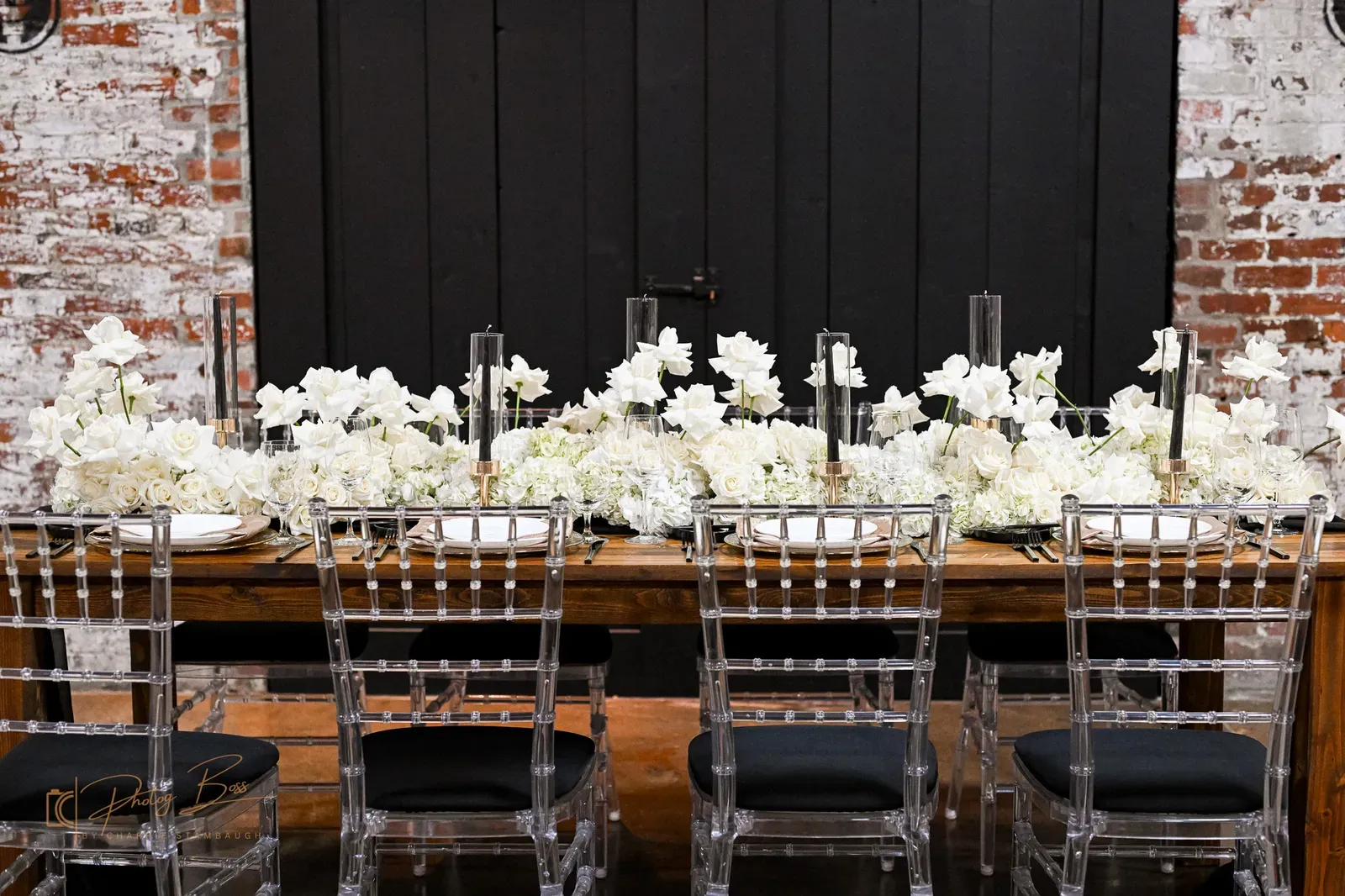
Photo: Photog Boss
Planning
Wedding Reception Planning in Indianapolis: Venues, Timelines & Tips
 By Sarah Conrad Updated May 19, 2026
 A wedding reception in Indianapolis runs roughly five hours from cocktail hour to send-off, costs about half your total wedding budget, and lives or dies by the timeline you build with your venue. Here is how to plan one that actually flows, written from inside 24 Shelby.
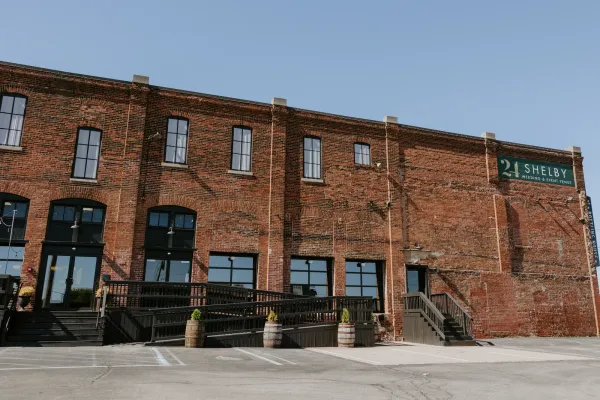
I have walked hundreds of couples through reception planning at 24 Shelby, the 1898 brewery turned wedding venue in downtown Indianapolis. The pattern is the same every time. Couples spend months on the venue search, then realize the reception itself, the part their guests will actually remember, gets planned in the last six weeks. This guide flips that. Pick the venue with the reception in mind. Build the timeline early. Everything else gets easier.
What follows is the playbook I use on every tour. How long a reception should run, what the timeline looks like hour by hour, how to choose a venue specifically for the reception (not just the ceremony), and the math on dance floors, bartenders, and the room flip.
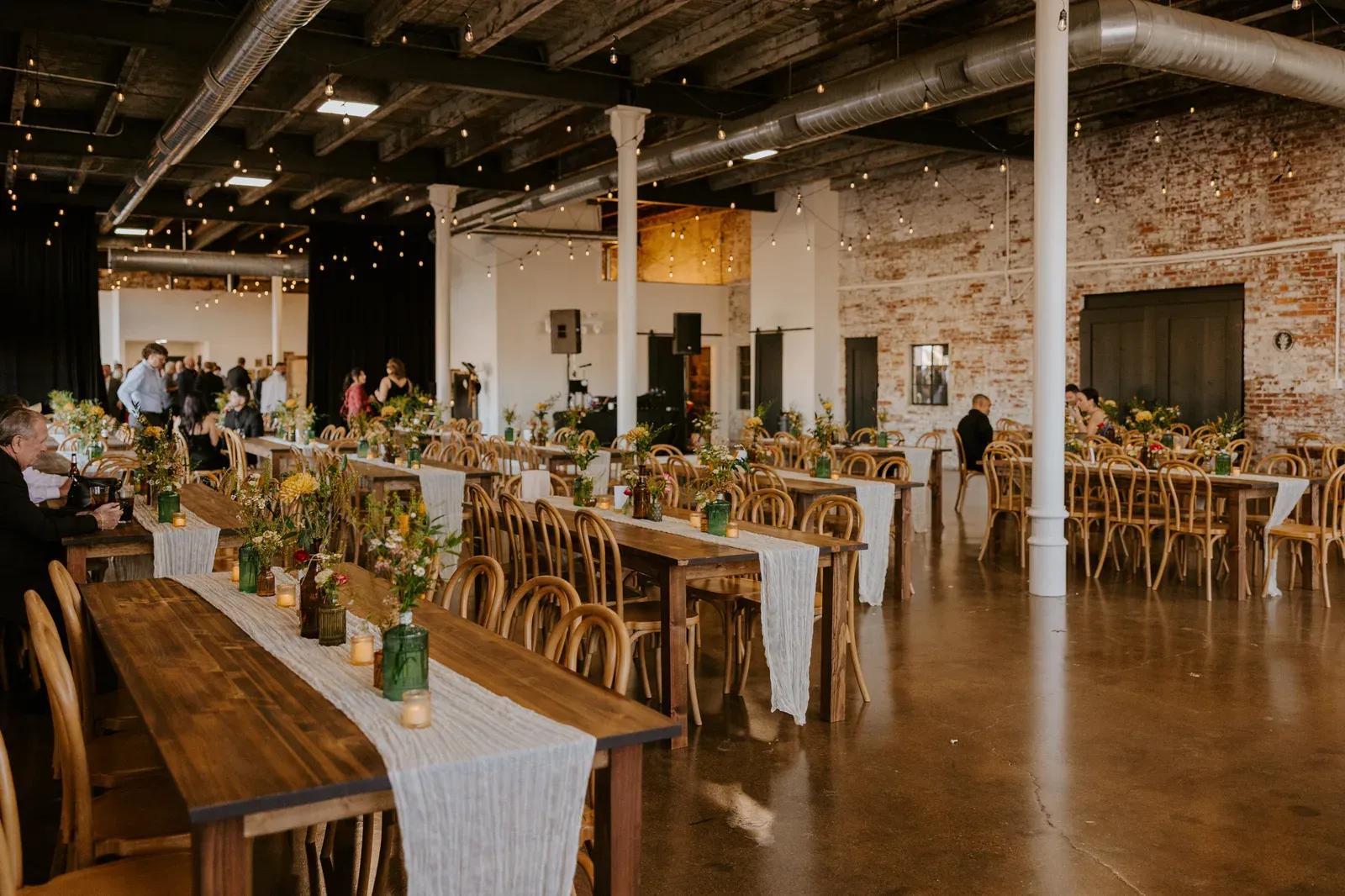 Photo: Photog Boss
How Long Should an Indianapolis Wedding Reception Be?
Most Indianapolis wedding receptions run five hours: one hour for cocktails, four hours for dinner and dancing. The Knot treats five hours as the standard reception length (The Knot, 2026). Four-hour versions cut the open dance floor short. Six-hour versions add late-night snacks or a second band set.
Length depends on guest count and venue end time. The national average wedding has 117 guests (The Knot, 2026), per their 2026 Real Weddings Study of 10,474 US couples married in 2025 (release). The Indianapolis-Carmel-Anderson metro runs higher, with 150 to 160 guests on average per The Wedding Report’s 2025 metro data (The Wedding Report, 2025; data). Bigger guest counts mean longer cocktail hours, longer dinner service, and a strong case for the five-hour minimum.
The other ceiling is your venue’s contract end time. Most downtown Indianapolis venues end at 11 PM or midnight. At 24 Shelby our standard wedding rental closes the bar at 11 PM and clears the venue by midnight. Mavris caps wedding access at midnight. Crane Bay similarly. INDUSTRY at 828 Venues runs unusual 24-hour rentals, which is flexibility most venues do not offer.
If you want a 6-hour reception ending at midnight, your cocktail hour starts at 6 PM and your ceremony has to land by 5 PM. Work backward from the contract end time, not forward from the ceremony. That single shift saves more late-night chaos than any other timeline trick.
According to Sarah Conrad, Managing Partner at 24 Shelby, “Guests don’t care about 90 percent of the details people stress over. They care whether the bar has a 20-minute wait and whether the dance floor is moving by 9 PM. Build the timeline around those two things and the rest takes care of itself.”
A Sample 5-Hour Wedding Reception Timeline
The cleanest five-hour reception runs 6 PM to 11 PM. Cocktail hour first, grand entrance and first dance second, dinner with toasts third, parent dances and cake fourth, open dance floor and send-off fifth. Each block runs about 60 minutes with a 15-minute buffer absorbed into dancing.
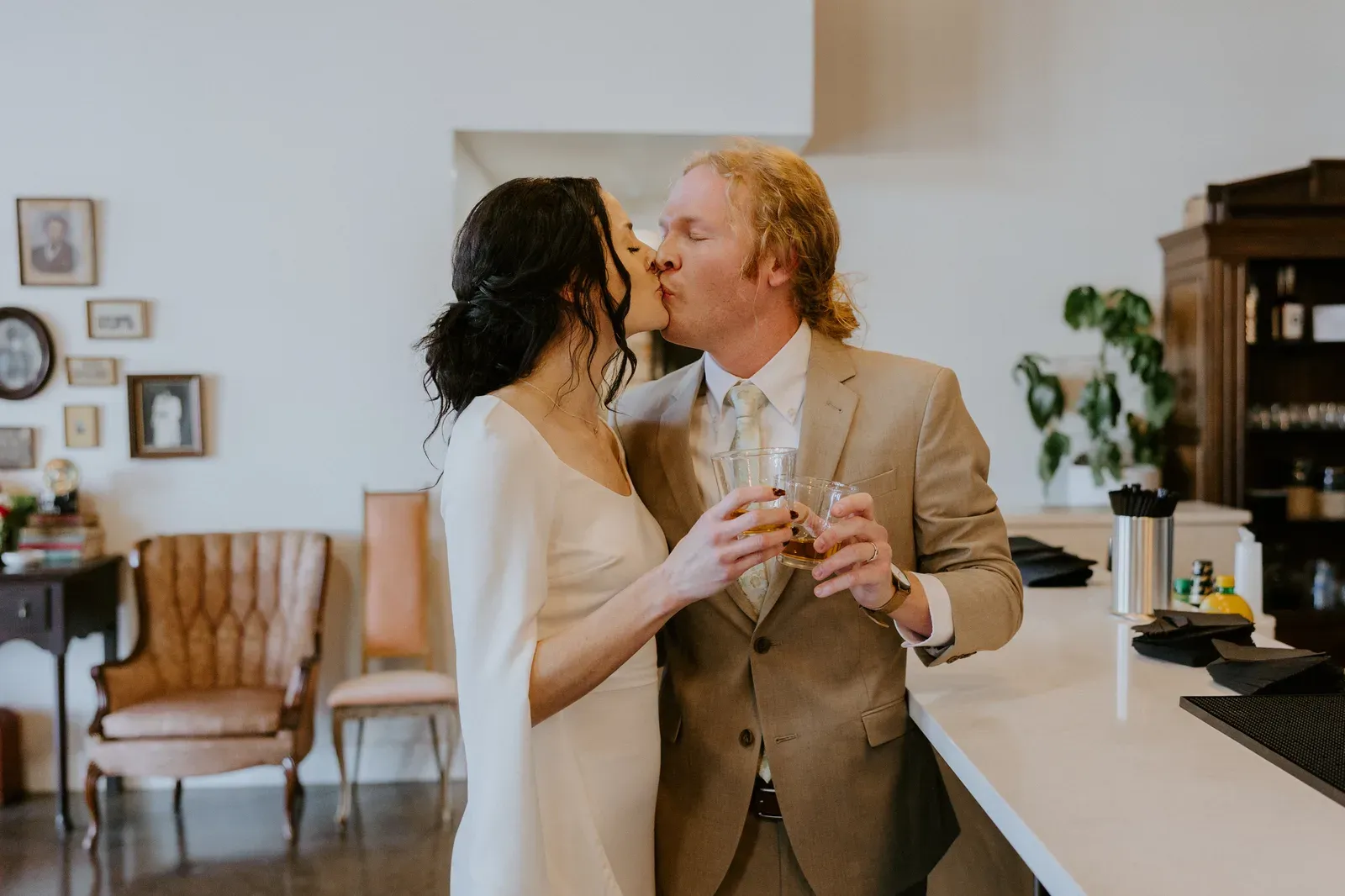 Photo: Clay House Photography
Here is the hour-by-hour breakdown 24 Shelby uses for a 150-guest reception in the Edison Room:
- 6:00 PM. Cocktail hour begins. Guests move from the ceremony space (or arrival) into the Libations Lounge. Bar opens. Passed appetizers circulate. The wedding party is in photos until about 6:50 PM.
- 6:55 PM. Final call to seats. The DJ or coordinator nudges guests toward the Edison Room. Bartenders top off. Last bathroom run before dinner.
- 7:00 PM. Grand entrance and first dance. Wedding party enters, then the couple. Straight into the first dance while everyone is still standing and watching. Don’t lose this moment to seating logistics.
- 7:15 PM. Welcome and dinner service begins. Brief welcome from the couple or a parent. Dinner runs 60 to 75 minutes for plated, 45 to 60 for buffet, faster for stations.
- 8:00 PM. Toasts. Best person speech, maid of honor speech, parents if they want. Cap each at 3 to 4 minutes. Schedule them while plates are being cleared.
- 8:30 PM. Parent dances and cake cutting. Father-daughter, mother-son, skip what doesn’t apply. Cake cutting goes here so the kitchen can plate dessert and clear.
- 8:45 PM. Open dance floor. The longest single block of the night. About two hours of dancing.
- 10:30 PM. Late-night snack drop. Optional but smart. Order for 60 to 75 percent of your guest count, since some guests leave early (Zola, 2026).
- 10:55 PM. Last call. Bar closes at 11.
- 11:00 PM. Send-off. Sparklers, bubbles, or a quiet exit. Couple departs. Guests follow.
If you want a buffer, build it between dinner and toasts (people running long on plates) or before the open dance floor. Both absorb easily without anyone noticing.
How Do 4-Hour, 5-Hour, and 6-Hour Reception Timelines Compare?
The trade-off is dance floor time. A four-hour reception protects your venue budget and vendor overtime fees, but lands at about 75 minutes of open dancing. A six-hour reception buys two and a half hours of dancing plus late-night programming. Five hours is the median for a reason.
| Length | Typical Hours | Cocktail | Dinner + Toasts | Open Dance Floor | Best For |
|---|---|---|---|---|---|
| 4 hours | 6 PM to 10 PM | 60 min | 90 min | ~75 min | Smaller guest counts (under 100), Sunday or weekday weddings, couples on a tighter venue contract |
| 5 hours | 6 PM to 11 PM | 60 min | 90 min | ~120 min | The Indy default. Works for 100 to 200 guests, downtown venues with midnight cutoffs |
| 6 hours | 5 PM to 11 PM, or 6 PM to midnight | 60 min | 90 min | ~150 min plus late-night programming | Larger receptions (200+), couples adding a second band set, late-night snack drops, multi-cultural ceremonies |
Most downtown Indianapolis venues are built around the 5-hour template. If you push to 6 hours, confirm the bar can stay open the full window, that vendor overtime is included or quoted up front, and that your DJ has enough music to actually fill the floor for two and a half hours.
How Do You Choose a Wedding Reception Venue in Indianapolis?
Pick a reception venue on eight criteria: seated and standing capacity, dance floor square footage, bar setup and staffing, acoustics, room flip mechanics, end-time curfew, catering policy, and hours included in the rental. Cost matters too, but it follows from these. Get these eight right and the budget conversation gets simpler.
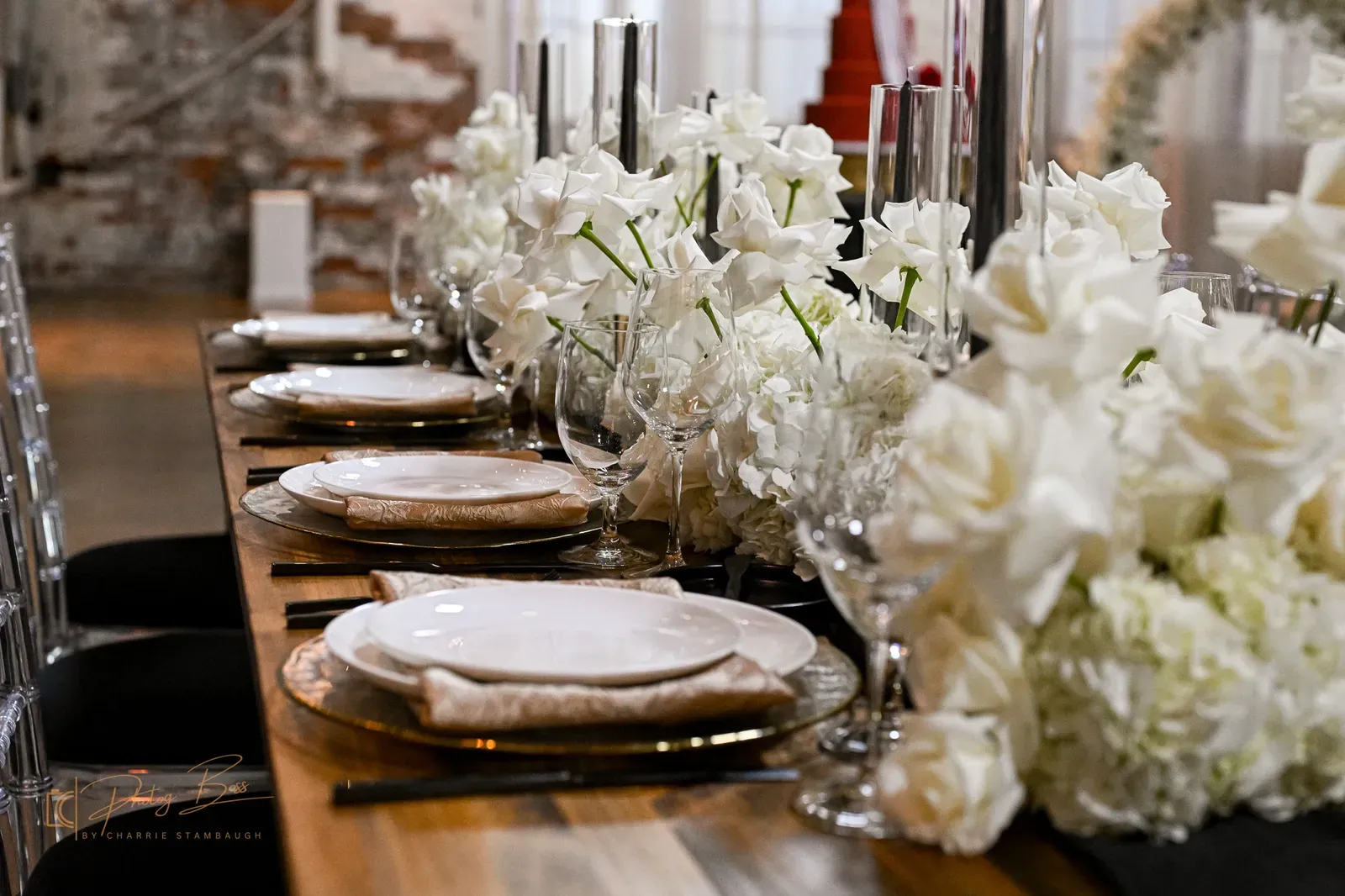 Photo: Photog Boss
Reception planning is where venues get evaluated differently than during the ceremony tour. Walk every venue with these eight reception-specific questions in mind:
- Seated AND standing capacity. Don’t trust a single number. A venue that seats 250 might only stand 280, which kills your cocktail hour. 24 Shelby seats 250 and stands 300+ in the same Edison Room.
- Dance floor square footage. Three square feet per dancer is the working rule. 30 to 50 percent of your guests dance at peak. Math the floor before you sign. (More on this below.)
- Bar setup and staffing. A 20-minute bar wait kills the night. Look at bar length, bartender count, and whether the bar is a chokepoint or part of the room.
- Acoustics for both toasts and dancing. Hard brick walls (most historic Indy venues) sound great for music and terrible for toasts unless the venue has a real PA. Ask.
- Room flip mechanics. If ceremony and reception happen in the same room, who flips it, how long does it take, and where do guests go during the flip? (Cocktail hour in a separate space is the gold standard.)
- End time and curfew. Mavris ends at midnight. INDUSTRY allows overnight rentals. Most downtown Indy venues land between 11 PM and midnight. This drives your start time.
- Catering policy. Mavris and Crane Bay (through Crystal Signature Events) and The Heirloom (also Crystal Signature) require in-house catering. INDUSTRY and 24 Shelby allow open catering. VisionLoft uses a preferred list with flexibility.
- Hours included in the standard rental. A 14-hour rental at Mavris (10 AM to midnight) versus a 4-hour Indianapolis City Market block is a wildly different planning load.
Here is how the major downtown Indianapolis reception venues compare on the four facts that drive reception logistics:
| Venue | Seated | Standing | Catering Policy | Bar Policy |
|---|---|---|---|---|
| 24 Shelby | 250 | 300+ | Open vendor (food prep kitchen on site) | In-house exclusive |
| INDUSTRY (828 Venues) | 300 | 500 | Open with flexibility | In-house exclusive |
| Mavris Arts & Event Center | 325 (300 single floor) | ~1,200 across floors | Exclusive in-house | Exclusive in-house |
| Crane Bay Event Center | 450 (High Bay rounds) | 1,500 max all spaces | Exclusive in-house (Crystal Signature) | In-house |
| The Heirloom at N.K. Hurst | ~200 to 250 | Not published | Exclusive in-house (Crystal Signature) | In-house |
| VisionLoft Mass Ave | 200 | 250 | Preferred list (open with discussion) | Not published |
For deeper coverage of Indianapolis venue options, see the complete guide to wedding venues in Indianapolis and the all-inclusive wedding packages comparison. For the 25 questions to ask on your venue tour, come back to that one once it lands.
How Big Should Your Wedding Dance Floor Be?
Plan three square feet per dancer, and assume 30 to 50 percent of your guests are on the floor at peak. For 150 guests that math lands at roughly 180 to 225 square feet, or a 15-by-15 area. The Edison Room at 24 Shelby handles that without losing dinner seating.
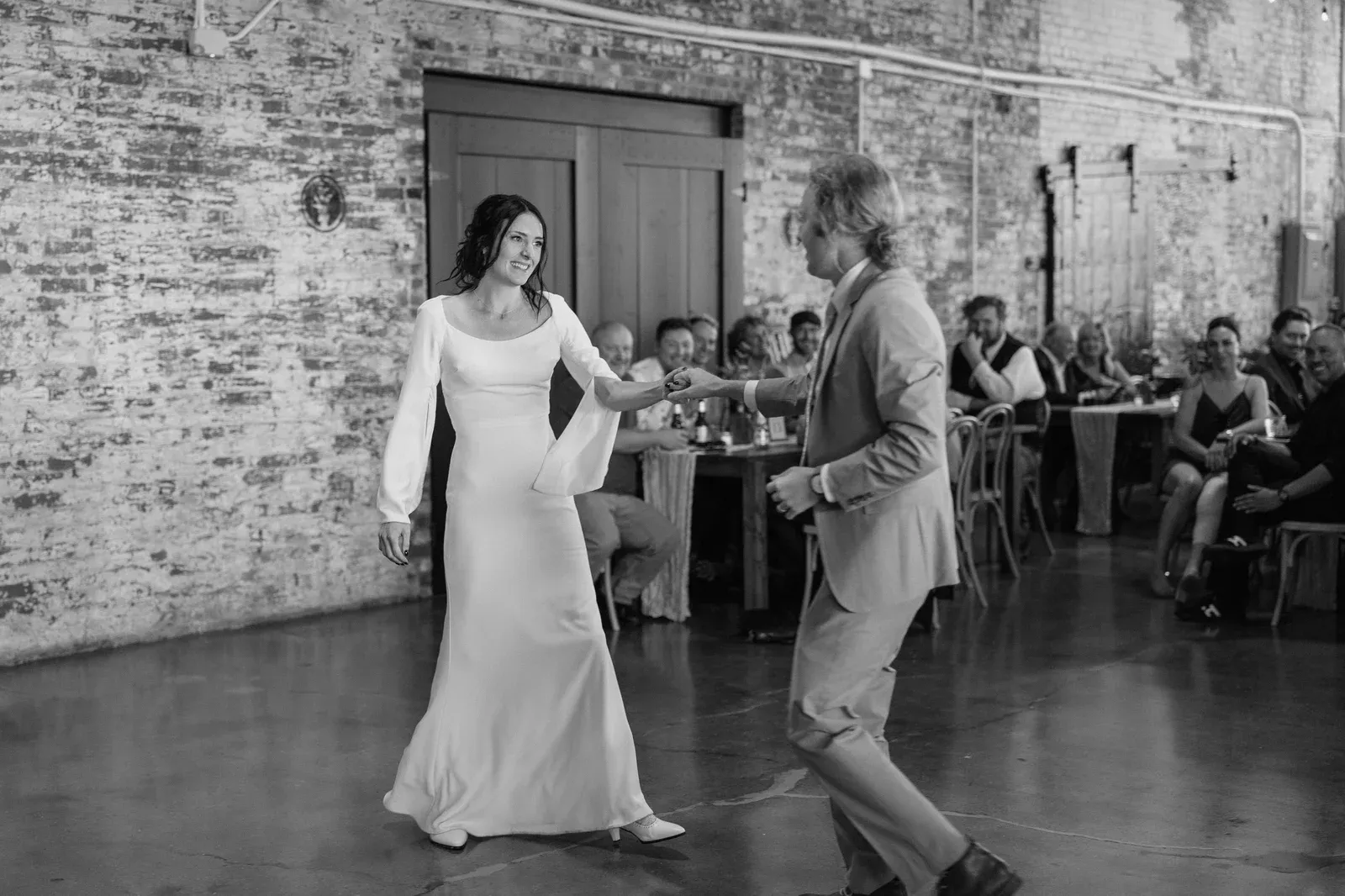 Photo: Clay House Photography
The dance floor is the single most under-planned element of a reception. Couples obsess over centerpieces and forget that 60 dancers shoulder-to-shoulder need real square footage. Here is the math by guest count:
| Guest Count | 30% Dancing | 50% Dancing (Peak) | Recommended Floor Size |
|---|---|---|---|
| 75 | 23 dancers | 38 dancers | 12 x 12 ft (144 sq ft) |
| 100 | 30 dancers | 50 dancers | 12 x 15 ft (180 sq ft) |
| 150 | 45 dancers | 75 dancers | 15 x 15 ft (225 sq ft) |
| 200 | 60 dancers | 100 dancers | 15 x 20 ft (300 sq ft) |
| 250 | 75 dancers | 125 dancers | 18 x 20 ft (360 sq ft) |
Two placement rules matter more than size. First, put the dance floor between the bar and the head table or band, never in a back corner. Floors fill from the center of the room, not the edges. Second, if your venue has high ceilings (every historic Indianapolis venue does, including 24 Shelby’s exposed wood beams), dancers spread out more than the math suggests because the room feels bigger. Build for 50 percent dancing if the venue is dramatic.
How Many Bartenders, Servers, and Vendors Do You Need?
Plan one bartender per 50 guests for a full bar, one server per 8 to 10 guests for plated dinner, one DJ for the room. The Knot’s 2026 Real Weddings Study reports couples hire 13 vendors on average, with 89 percent booking a venue, 88 percent a photographer, and 85 percent a caterer (The Knot, 2026).
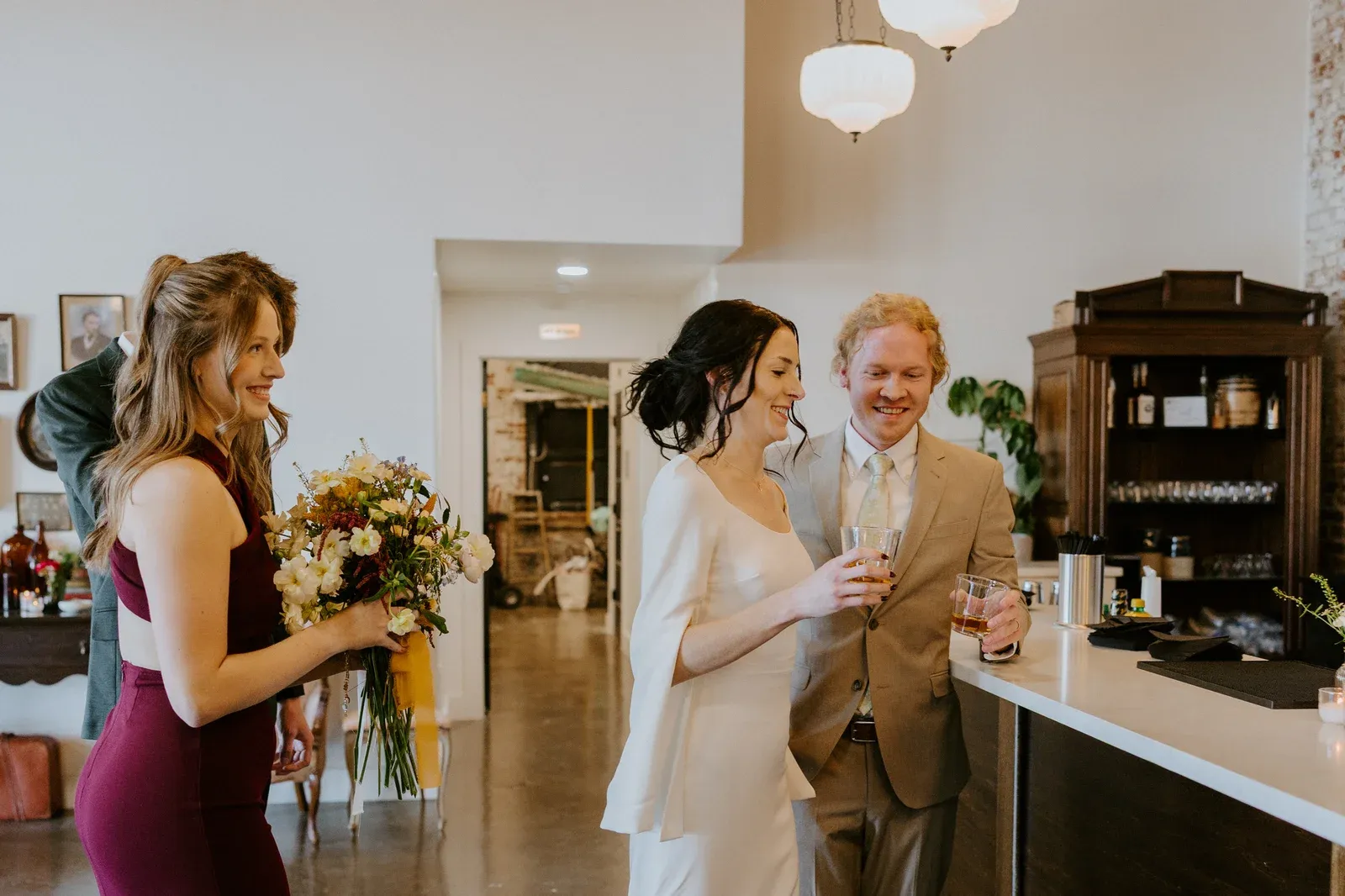 Photo: Clay House Photography
The bartender ratio is non-negotiable. One bartender per 50 guests for a full bar, one per 75 for beer and wine only. Below that ratio, the line becomes the night. Above it, you’re wasting money on staff who aren’t pouring. At 24 Shelby we run our in-house bar with two bartenders for receptions of 100 to 150 and three for 200+, scaled to the bar package and how heavy the cocktail program is.
Server ratios depend on service style. Plated dinner needs one server per 8 to 10 guests. Buffet needs one per 30. Family-style sits between, around one per 12. Stations are the lightest staffing load and the most engaging format, which is why about half of couples are now considering interactive food stations like grazing tables and charcuterie boards (Zola, 2026).
DJ choice is more about personality than technology. The Knot 2026 study found 53 percent of couples cite personality as the top factor when hiring a DJ (The Knot, 2026). Tour your DJ at a real wedding before signing if you can.
Sarah Conrad on the bar specifically: “I’m not gonna ask my bartenders to do anything I wouldn’t do. It’s their liquor licenses on the line. Couples sometimes ask us to keep pouring for someone who’s clearly past their limit. The answer is no, every time. That protects the night, and it protects the guest. The morning after is always easier when nobody got cut off at 10 PM.”
For the deep dive on catering specifically, see the Indianapolis catering guide.
How Do You Run a Ceremony-to-Reception Room Flip?
The room flip is when the same space becomes the ceremony, then the reception. Guests move to a separate cocktail space for 45 to 60 minutes. Your venue team flips chairs, places tables, sets centerpieces, and reopens. Done well, the reveal feels like walking into a different building.
 Photo: Clay House Photography
Most Indianapolis venues that hold both ceremony and reception under one roof use a room flip. The mechanic is simple. The choreography is not. At 24 Shelby the flow runs like this: ceremony in the Edison Room with chairs in rows, guests usher into the Libations Lounge for cocktail hour, the venue team strikes the ceremony chairs and rolls in tables, reception furniture lands, the curtain reopens, and 250 guests walk back into a fully transformed room.
Sarah Conrad on what couples don’t see: “It’s like a whole new space but all within the same space. Our team has the flip down to about 45 minutes, but to a guest it feels instant because they’re in the bar laughing during all of it. That curtain reveal gets gasps every single time. That’s the moment people remember.”
The decision tree on whether to do a room flip versus separate ceremony and reception spaces:
- Same room (flip): Lower total cost, no shuttle logistics, guests stay put, the reveal moment lands. Requires a venue with cocktail hour space separate from the main room. 24 Shelby, INDUSTRY, Mavris, Crane Bay, The Heirloom, and VisionLoft Mass Ave all support this.
- Separate spaces: More breathing room for ceremony length, no time pressure on the flip, traditional church ceremonies still work. Adds shuttle cost or guest driving, a non-trivial Indianapolis problem in winter or downtown event nights.
Per Zola’s 2026 First Look Report (Zola, 2026), 18 percent of couples are now opting for a full two-to-three day wedding weekend, and 37 percent are hosting at least one additional event like a welcome party or day-after brunch (report). If you’re already booking multiple days, the all-under-one-roof room-flip model removes one more logistics headache.
How Much of Your Wedding Budget Goes to the Reception?
The reception consumes about 53 percent of a typical wedding budget: 29 percent for venue and rentals, 24 percent for catering, cake, and drinks (The Knot, 2026). Music adds another 6 percent. Photography and videography another 10. Reception logistics drive roughly two thirds of total wedding spend (The Knot budget breakdown).
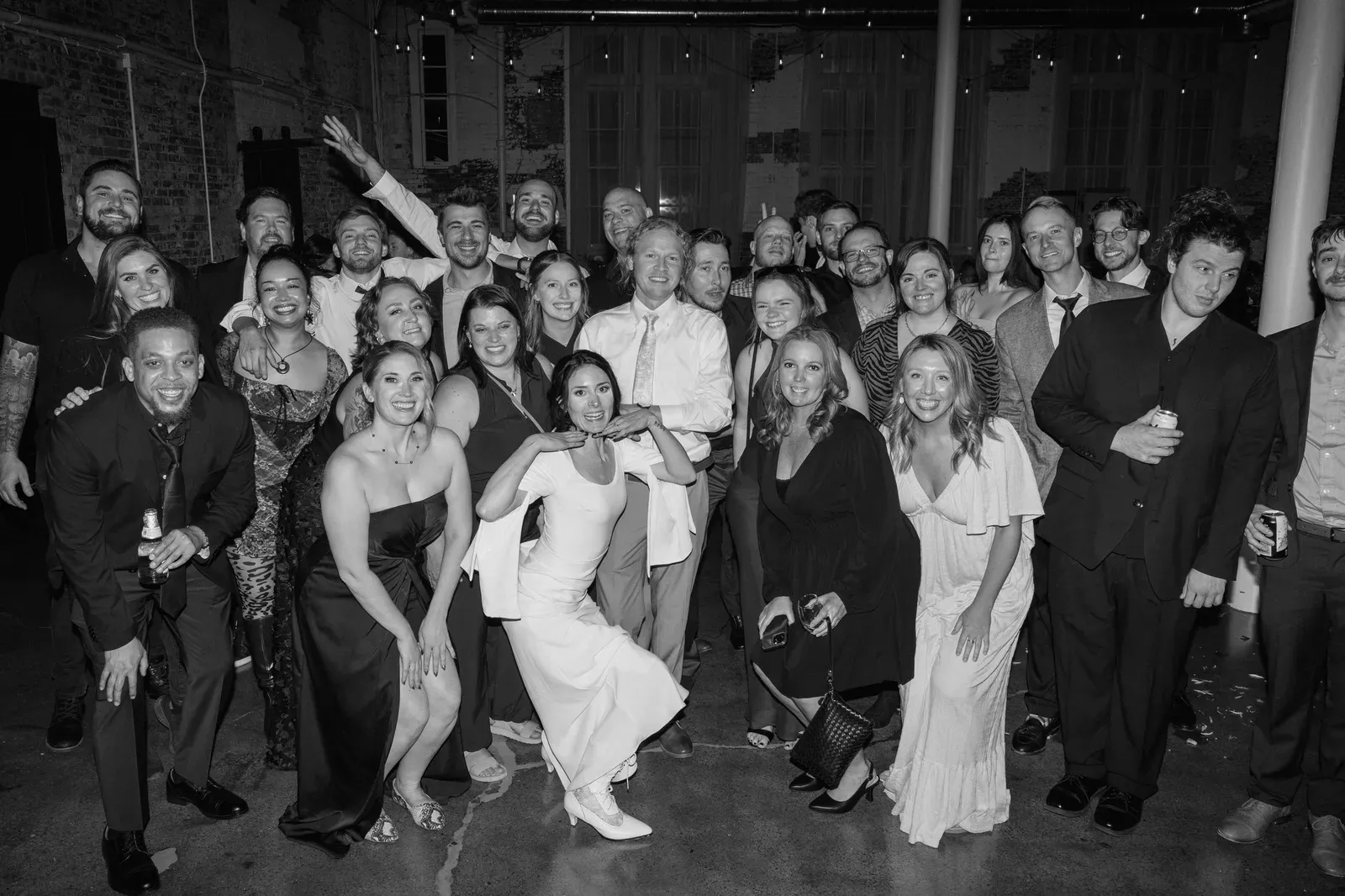 Photo: Clay House Photography
The Indianapolis-Carmel-Anderson metro hosted 11,694 weddings in 2025, with average guest counts running 150 to 160 (The Wedding Report, 2025). That’s substantially larger than the national average of 117 guests per wedding (The Knot, 2026). Bigger guest counts mean bigger receptions: more bartenders, more square footage, more dance floor, more time. The budget allocation pattern holds across both: roughly half of every wedding dollar lands on reception logistics.
Where to save without sacrificing the reception experience:
- Cut the cocktail hour to 45 minutes if you’re under 100 guests. You save bar staffing time and tighten the night without anyone noticing.
- Buffet or stations beat plated for staffing cost, and station-style food is trending up anyway (Zola, 2026).
- Pick a venue with furniture included so you skip rental fees on chairs, tables, and lounge pieces. 24 Shelby includes everything in the rental, which is one of the reasons couples choose mid-tier venues over blank-canvas spaces.
- Photo booths show up at 68 percent of weddings now (Captured Celebrations, 2026), with most couples booking three to six months ahead. Cheaper than upgraded floral. Higher engagement.
For the full Indianapolis wedding cost breakdown, see the Indianapolis wedding cost guide and the all-inclusive packages comparison. When you’re ready to walk a real reception space, you can book a tour at 24 Shelby.
The reception is the part of your wedding day your guests will actually talk about for years. The dance floor, the bar, the late-night snack drop, the room-flip reveal, the timing of the toasts. The venue is the stage. The timeline is the script. Spend the planning time here, and the rest of the day takes care of itself.
Frequently Asked Questions
How long should a wedding reception be in Indianapolis?
Most Indianapolis wedding receptions run five hours: one hour for cocktails followed by four hours for dinner and dancing. The Knot treats five hours as the standard reception length. Four-hour versions cut the open dance floor short for larger guest counts. Six-hour receptions add late-night snacks or a second band set and need a venue contract that allows midnight or later end times.
What is the typical order of events at a wedding reception?
A standard reception runs cocktail hour, grand entrance and first dance, dinner with toasts, parent dances and cake cutting, then open dance floor and send-off. Each block runs about 60 minutes. Build a 15-minute buffer between dinner and toasts to absorb dinner service running long, which is the most common timeline slip across Indianapolis weddings.
How much of a wedding budget goes to the reception?
The reception itself accounts for about 53 percent of a typical wedding budget: roughly 29 percent for venue and rentals plus 24 percent for catering, cake, and drinks (The Knot, 2026). Music adds another 6 percent. Photography and videography add 10. Reception logistics drive roughly two thirds of total wedding spend across most Indianapolis budgets.
How big should a wedding dance floor be?
Plan three square feet per dancer. Assume 30 to 50 percent of guests are on the floor at peak. For 100 guests that means roughly 150 square feet (12 by 13). For 150 guests, 225 square feet (15 by 15). For 200 guests, 300 square feet (15 by 20). Larger and the floor reads empty. Smaller and dancing breaks down quickly.
How many bartenders do I need for a wedding reception?
Plan one bartender per 50 guests for a full bar, or one per 75 for beer and wine only. Below that ratio, the bar line becomes the night. For a 150-guest reception, two to three bartenders is right. At 24 Shelby we run two for 100 to 150 guests and three for receptions over 200, scaled to how heavy the cocktail program is.
How far in advance should I book a wedding reception venue in Indianapolis?
Saturday weddings in peak season (May through October) book 12 to 18 months out at downtown Indianapolis venues. Premium dates run 18 to 24 months. Friday and Sunday receptions and off-season dates (January through March) often have 3 to 6 month lead times. December is the most popular month to get engaged, so January through April is the heaviest venue-shopping season.
Do I need a wedding planner if my venue has a coordinator?
A venue coordinator manages the venue: setup, breakdown, room flips, vendor access, the bar, the timeline once the day starts. A wedding planner manages the wedding: vendor selection across the prior 12 months, design, contracts, family logistics, day-of vendor management. Many Indianapolis couples use both. If you can only choose one and your venue has a strong coordinator, hire a day-of planner instead of a full planner.
Related Reading

Planning
Just Got Engaged in Indianapolis? Your First 30-Day Checklist
Just got engaged in Indianapolis? Here's exactly what to do first: a week-by-week 30-day checklist from inside a downtown venue. Celebrate, budget, then book.
Planning
Rehearsal Dinner Venues in Downtown Indianapolis: Top Picks
Ten rehearsal dinner venues in downtown Indianapolis: private-room capacities, walking distance from your wedding, and the etiquette on who pays.
Planning
Downtown Indianapolis Wedding Weekend Guide: Hotels, Dining & More
Hotels, rehearsal dinners, brunch, and things to do for downtown Indianapolis wedding guests. Built around 24 Shelby, for couples planning the whole weekend.