Photo: Photog Boss
Budget
All-Inclusive Wedding Packages in Indianapolis: What's Included (2026)
 By Sarah Conrad Updated Aug 28, 2026
 All-inclusive wedding packages in Indianapolis come in three tiers: venue-only (the room and basic furniture), venue plus services (room, furniture, in-house bar, setup, coordinator), and true all-inclusive (one contract for venue, food, drink, and team). Venues use the same label for all three, so knowing which tier a quote fits is how you compare packages that look identical on paper.
I have walked hundreds of couples through this conversation at 24 Shelby. Most of them walk in believing “all-inclusive” means one thing. By the end of the tour, they realize it means at least three. Here is the framework I use to break it down.
 Photo: Photog Boss
What Does “All-Inclusive” Actually Mean for an Indianapolis Wedding Venue?
“All-inclusive” is a marketing term, not a standard. Indianapolis venues use it for everything from a bare ballroom rental that comes with chairs to a package that bundles food, drink, design, and a coordinator into one contract. The Knot’s 2025 Real Weddings Study found that 30% of US couples booked an all-inclusive wedding venue (The Knot, 2025), and almost no two of them mean the same thing. Read the full study here.
Functionally there are three tiers. The Knot describes the top tier as venues that “provide standard wedding services through an in-house team of professionals, so they’re able to take much of the research off your plate.” The bottom tier is a venue-only rental dressed up in better marketing copy. The middle tier (where 24 Shelby sits) is the most common in the Indianapolis market and the most often mislabeled.
What Are the Three Tiers of Indianapolis Wedding Venue Packages?
Here is the comparison every couple should run before booking a tour. Each tier has different inclusions, different out-of-pocket costs after booking, and a very different planning workload.
| Tier | What’s Included | What’s Not | Vendor Coordination Load | Indianapolis Examples |
|---|---|---|---|---|
| Tier 1: Venue-Only | The space, basic tables and chairs, sometimes Wi-Fi and lighting | Catering, bar, decor, planner, setup help | High. Couple manages 10+ vendors. | INDUSTRY (828 Venues), Indianapolis City Market, VisionLoft |
| Tier 2: Venue Plus Services | Venue, all furniture, in-house bar service, setup and breakdown, coordinator | Catering, photo, DJ, florist | Medium. Couple manages 5 to 7 vendors. | 24 Shelby, The Sycamore at Mallow Run, Daniel’s Vineyard |
| Tier 3: True All-Inclusive | Venue, food, beverage, in-house design, coordinator, sometimes officiant | Photo, DJ, florist (occasionally included) | Low. Couple manages 3 to 5 vendors. | The Heirloom at N.K. Hurst, Crane Bay, Mavris Arts & Event Center, Hotel Carmichael |
The Knot 2026 Real Weddings Study reports couples hire an average of 13 vendors for a wedding (The Knot, 2026), based on a survey of 10,474 couples married in 2025 (study release). A Tier 1 booking leaves nearly all of that work on you. A Tier 3 package can collapse it to four or five outside vendors. The right answer is whichever tier matches the planning energy you actually have.
Tier 1: Venue-Only Rentals (What’s Included and What Isn’t)
A venue-only rental gives you the space and basic furniture for a few hours. Catering, bar service, decor, coordinator, and almost everything else are your problem. You get full vendor freedom and the lowest sticker price. You also do most of the planning yourself.
In Indianapolis, three venues are the cleanest examples of this tier:
- INDUSTRY (828 Venues) publishes itself as a true blank canvas. The rental includes farmhouse tables and chairs for 200, a divisible client suite, market lights, Wi-Fi, and a dedicated client concierge. Catering is open vendor; in-house INDUSTRY Beverage is the only required exclusive when alcohol is served (INDUSTRY 828 Venues, 2026).
- Indianapolis City Market rents the historic downtown space for 4 hours of event time, with tables, chairs, podium, piano, day-of coordinator, and venue setup and cleanup included. Catering must come from an approved list and there is no on-site kitchen. Alcohol is bring-your-own through a licensed bartender.
- VisionLoft Mass Ave offers exclusive use of the space from 8 AM to midnight. Existing seating, the touch video wall, and black glassboards are included. Catering and bar are couple-sourced through a long preferred list, but outside caterers are explicitly allowed.
Tier 1 is the right call for couples who already have a planner, already know exactly what they want, and don’t mind chasing 10+ separate contracts. It’s the wrong call for couples who think “rental fee” is the total cost. Plan to spend the rental fee plus catering, plus bar, plus rentals beyond what’s provided, plus a day-of coordinator, plus everything else.
For the smallest-budget version of this tier, see the budget Indiana wedding venues guide.
Tier 2: Venue Plus Services Packages (Where 24 Shelby Sits)
Tier 2 is the middle ground and the most common Indianapolis package type. The venue rental includes the space, all furniture (chairs, tables, lounge pieces, sometimes lighting), in-house bar service with professional bartenders, setup and breakdown by the venue team, and a dedicated coordinator who runs the day. Catering is typically open vendor through an on-site prep kitchen. Photo, DJ, and florist are couple-sourced.
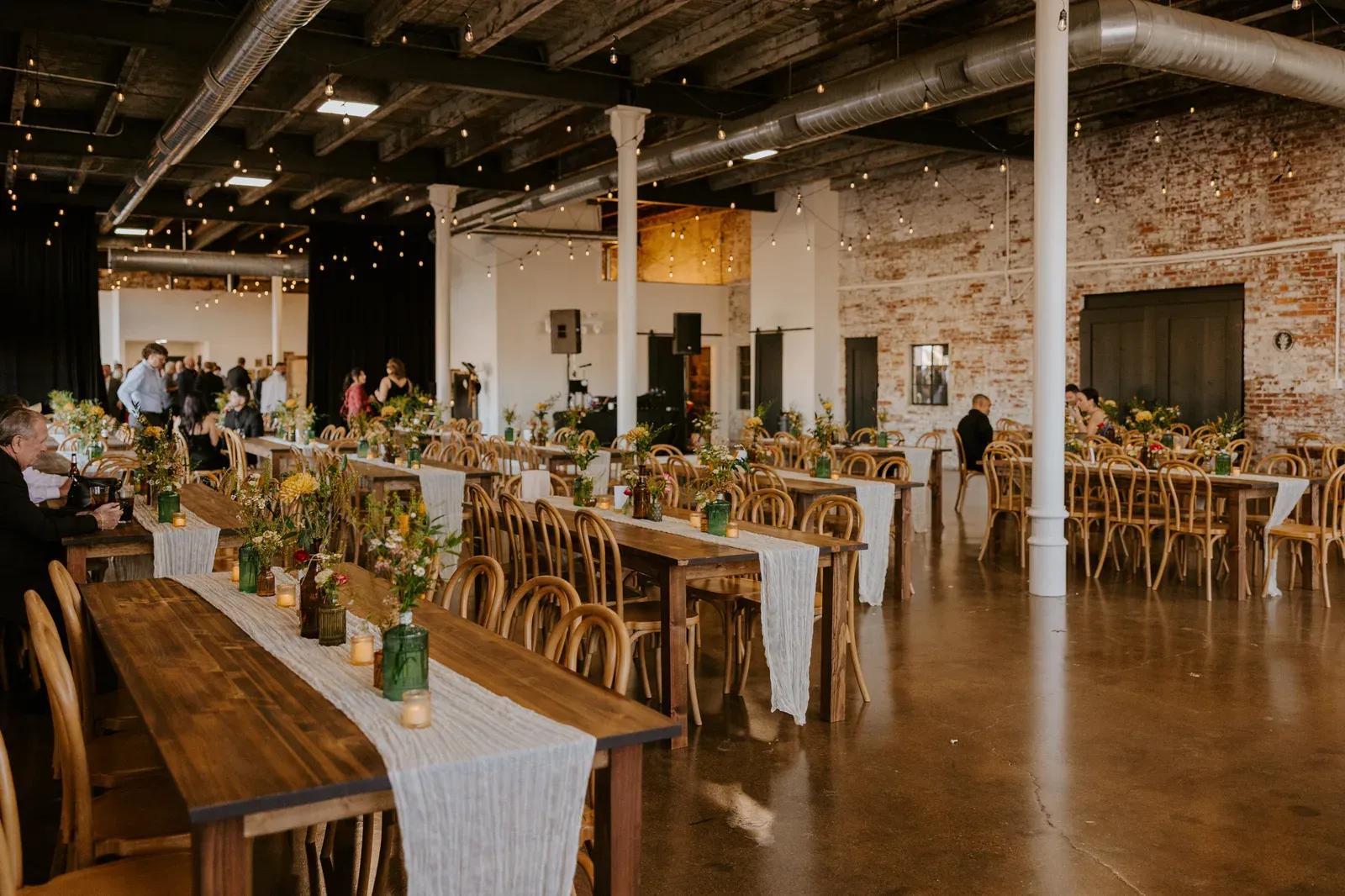
This is where 24 Shelby sits. Our wedding packages include the 6,000 square foot Edison Room, the Libations Lounge, the Rosewood bridal suite (with 7 AM access), the Prohibition Patio, every piece of furniture in the building, in-house bar service, setup and breakdown, and a dedicated event coordinator. Couples bring their own caterer through our prep kitchen and choose their own photo, DJ, and florist.
 Photo: Clay House Photography
Other Indianapolis venues in this tier:
- The Sycamore at Mallow Run (Bargersville, about 20 miles south of downtown) bundles the Estate Room, two bridal suites, dance floor, event coordinator, lighting, sound, and Wi-Fi. In-house bar packages are required. Catering is from a preferred list with a buyout fee for non-preferred vendors.
- Daniel’s Vineyard (McCordsville) bundles a 9-hour rental of the Upper Ballroom, Bridal Suite, gold Chiavari chairs for 200, round tables, Hue lighting, projector, professional house audio, parking, and onsite security. The beverage package and preferred caterer requirements are in-house exclusives.
- Biltwell Event Center sits between Tier 2 and Tier 3 depending on the path you choose. The rental fee covers Edison lighting, farm tables, ceremony arch, custom rolling cocktail tables, and 12 hours of event time. Catering and alcohol are typically in-house, and the all-inclusive package upgrade is optional.
Location moves the number too. According to Jacqueline Truesdale, General Manager of Beau Truesdale Wedding Venues, “urban venues and popular destination spots tend to be more expensive than rural or suburban locations” (The Knot, 2026). Keep that in mind when a Bargersville or McCordsville Tier 2 quote comes in under a downtown one: you are comparing location as much as inclusions.
The pitch for Tier 2 is real for one reason: the bar, the furniture, and the coordinator are the three line items most couples either underestimate or get burned on. Bundling them with the room takes the volatility out of the budget. You still get to pick the food (which 58% of couples say is a top priority per The Knot, 2025) and the photographer, where personal taste matters most.
 Photo: Clay House Photography
For the broader Tier 2 set across the metro, see the affordable Indianapolis wedding venues guide.
Tier 3: True All-Inclusive Wedding Packages
A true all-inclusive package collapses 8 to 10 separate vendor contracts into one. Venue, food, beverage, all rentals, design support, and the day-of team come from the same company under the same contract and one final invoice. This is the tier The Knot has in mind when it says all-inclusive venues take “much of the research off your plate” (The Knot, 2025). In Indianapolis the model exists at four venues worth knowing:
- The Heirloom at N.K. Hurst (downtown) is paired with Crystal Catering as the in-house preferred caterer. The package includes a coordination team, 25 birchwood farm tables, 400 vineyard crossback chairs, multiple round and banquet options, three portable bar units, fabric couches and vintage carts, a 50-foot drape, market lights, glassware, china, flatware, suites for both wedding parties, and 300 complimentary parking spaces. A service charge bundles setup, tear down, serving staff, and kitchen labor. The ceremony is a separate line item, and a food and beverage minimum applies.
- Crane Bay Event Center explicitly bundles 12 hours of event time, draping that sections the 18,000 square foot space into 4 zones, tables, chairs, linens, glassware, in-house sound, outdoor lighting, votive candles, white leather couch pieces, manually operable cranes (the venue’s signature), shot chandelier, appetizer wall, portable bars, day-of coordinator, and full kitchen access. All catering and alcohol come through the venue. Music ends at midnight.
- Mavris Arts & Event Center runs an in-house catering exclusive (no outside food or beverage permitted, with a licensed bakery dessert exception). The wedding package bundles 14 hours of access, an event designer, separate wedding party suites, parking for all guests, in-house ceremony decor, indoor and outdoor ceremony options with a rain plan, overnight decor storage, resin chairs, table linens and napkins (any color), specialty lighting and AV, and the in-house executive chef. Food and beverage tax and an administrative fee are added on top of the package.
- Hotel Carmichael (Carmel) runs a boutique hotel all-inclusive model. Ballroom or al fresco Palladium Gardens ceremony, in-house catering, F&B team, hotel block availability for guests, and event coordination are bundled into one quote.
True all-inclusive is the right move for couples who want the planning load light, who care more about their photographer’s eye than their bartender’s pour list, and whose budget can absorb the full bundle. It’s the wrong move for couples who already have a vision for the food, the bar program, or the design. Those are the parts that get standardized inside the package.
 Photo: Photog Boss
How Do You Compare Two Indianapolis Wedding Venues Apples to Apples?
Compare on six questions, asked of every venue, in writing. The headline rental fee is almost never the comparable number.
- What’s in the rental fee? Rooms, hours, furniture, lighting, AV, suites, parking. Get specifics. “Furniture” without a chair count is not an answer.
- What’s required to add? Catering minimums, bar packages, ceremony fees, security, valet, day-of coordinator if not already included.
- What’s mandatory through the venue? In-house bar, in-house catering, exclusive vendor lists with buyout fees. These are the line items where price negotiation goes away.
- What’s the service charge and what does it cover? A 20% to 24% service charge on the food and beverage minimum is often the largest line item after the food itself. It usually covers setup, tear down, and labor. Ask whether gratuity is on top of it.
- What’s taxed? Indiana’s 7% sales tax applies to venue rental and food and beverage but not all line items. Get a sample full invoice with tax broken out.
- What’s an overage? Overtime past contract end time, cake cutting, corkage, vendor meals, chair upgrades, ceremony chair flips, additional bartenders for guest counts above the package threshold.
Then build a side-by-side spreadsheet. Apples to apples means total all-in cost for your guest count and timeline, not the marketing rental fee.
What’s Almost Always Excluded From an “All-Inclusive” Package?
Even the most bundled Indianapolis venues exclude the same handful of categories. Plan to source these no matter which tier you book:
- Photography and videography
- Florist and bouquets
- DJ or live music
- Hair and makeup for the wedding party
- Wedding attire and alterations
- Stationery, save-the-dates, day-of paper
- Officiant (free if a friend gets ordained for the day)
- Transportation for guests staying outside walking distance
- Indiana’s 7% sales tax on venue and catering
- Service charges of 18% to 22% on food and beverage at most full-service venues
- Gratuities for vendors not covered by service charges
The team at Radius Venue, an Indianapolis hybrid wedding venue, put it bluntly in their 2025 piece on the topic: “Even ‘all-inclusive’ doesn’t always mean all costs are included. While catering and rentals might be included, you still have to find a florist, DJ, photographer, and several other vendors. Be sure to also ask about taxes, gratuities, and overtime charges” (Radius Venue, 2025).
For a deeper read on what’s actually inside a venue rental at each tier, see the what’s included in a venue rental guide.
Are All-Inclusive Wedding Venues Worth It in Indianapolis?
For 30% of couples, yes (The Knot, 2025). For everyone else, the right answer depends on three things: how many vendors you actually want to manage, how much price predictability matters to you, and how much creative control you want over the food, the bar, and the design.
The case for true all-inclusive (Tier 3): time savings, fewer surprises, single point of contact, easier final-week timeline. Industry estimates put end-to-end wedding planning at 200 to 350 hours, and all-inclusive packages save roughly 40 to 50 hours of vendor research and coordination (MMCG Invest, 2026).
The case for venue plus services (Tier 2): you keep control of the food (a real differentiator since 58% of couples cite food and beverage as a top priority), photo, and DJ. The three categories most likely to show up in your guests’ memories. The bar, the room, and the coordinator are bundled, which removes the volatility from the line items most couples underestimate.
The case for venue-only (Tier 1): lower sticker price, full vendor freedom, and the highest ceiling on creative customization. The trade-off is a 10+ vendor coordination load on top of everything else you’re already doing.
“Guests don’t care about 90% of the details people stress over. They remember the bar, the food, and how they felt on the dance floor. Pick the tier where you can deliver those three things without losing your mind.”
According to Sarah Conrad, Managing Partner at 24 Shelby.
If your guest list is 100 to 200 people and your timeline is under 12 months, Tier 2 is almost always the right call in the Indianapolis market. You get the structural items bundled (which removes the surprise costs) and you keep creative control on the items couples care most about.
 Photo: Photog Boss
The Hidden Costs to Ask About Before You Sign
Zola’s 2026 Wedding Spend Survey found that 75% of couples encounter at least one surprise fee (Zola, 2026). Mandatory venue service fees hit 57% of couples, and those couples averaged double the unexpected total fees of couples whose venues didn’t charge one (full Zola report).
Common hidden costs in Indianapolis all-inclusive packages:
- Service charge of 18% to 22% on food and beverage minimums. It is calculated before tax, and tax is often applied on top of it.
- Indiana sales tax of 7% on venue rental and catering. Some service charges are also taxable depending on the venue’s setup.
- Ceremony fee separate from reception fee. Standard at most full-service venues, including The Heirloom.
- Cake cutting fees. Charged per slice at venues that don’t bake the cake themselves, so the total scales with your guest count.
- Corkage fees. If you bring your own wine into a venue with an exclusive bar, expect a per-bottle charge.
- Overtime charges. Most contracts end at midnight. Going past it is billed by the hour, and the hourly rate is rarely small.
- Vendor meals. Photographer, DJ, planner, and their assistants need to eat. Plan on 4 to 8 vendor meals, usually at a reduced per-plate rate.
- Chair, linen, and tabletop upgrades. The package linens are usually beige polyester. Anything else is a per-piece upgrade.
Get a sample full invoice from any venue you’re considering. The venue rental line is almost never the all-in number.
For more on the structural cost categories, see the Indianapolis wedding cost guide and the hidden cost deep dive.
 Photo: Photog Boss
Touring Indianapolis Wedding Venues With This Framework
Take this comparison framework into every venue tour. The headline rental fee tells you almost nothing. The total package cost (rental plus required additions plus service charges plus tax plus the categories you have to source separately) is the only number worth comparing.
For a deeper look at the broader Indy wedding market, the complete Indianapolis wedding venue guide walks through the categories side by side.
Tour 24 Shelby in person to see what Tier 2 actually feels like. The package, the Edison Room and Rosewood bridal suite, and the wedding-specific service menu all live in the same building. The story behind 24 Shelby explains why we built the package the way we did, and the tour request form gets you in front of the room with a coordinator who can answer the six questions above for your specific date.
Frequently Asked Questions
What is included in an all-inclusive Indianapolis wedding package?
It depends entirely on the tier. A venue-only rental usually includes the space, basic tables and chairs, and a few hours of access. A venue-plus-services package adds bar service, all furniture, setup and breakdown, and a coordinator. A true all-inclusive package adds catering, beverages, sometimes design, and one contract covering everything but photo, DJ, and florist. Always ask for the line items in writing.
Are all-inclusive wedding packages worth it?
Yes for couples who value time and predictability over per-line-item negotiation. The Knot 2026 Real Weddings Study reports couples hire an average of 13 vendors for a wedding ([The Knot, 2026](https://www.theknotww.com/press-releases/the-knot-worldwide-unveils-2026-real-weddings-study/)). All-inclusive packages cut that vendor list roughly in half. The trade-off is less choice on caterer, bar program, and decor styling.
What does a complete wedding package include?
A complete wedding package, also called a true all-inclusive package, bundles the venue, catering, bar service, tables, chairs, linens, setup and breakdown, and a coordinator into one contract and one invoice. Most still exclude photography, florals, music, attire, and the officiant. In Indianapolis, The Heirloom at N.K. Hurst, Crane Bay, Mavris, and Hotel Carmichael run this model. 24 Shelby bundles the venue, furniture, bar, and coordinator and leaves catering open.
What's the difference between all-inclusive and a la carte wedding venues?
All-inclusive bundles vendors into one contract and one bill. A la carte means you book the venue, then build the rest from scratch: caterer, bar, DJ, florist, photographer, coordinator. A la carte gives you full control and often lower total cost when you do the work. All-inclusive saves time and lowers the risk of surprise gaps. There's no universally right answer; it depends on how much planning energy you actually have.
What is NOT included in most 'all-inclusive' wedding packages?
Photography, videography, florist, DJ or band, hair and makeup, attire, stationery, transportation, and Indiana's 7% sales tax. Even at the most bundled venues, couples still hire 5 to 7 outside vendors. Service charges of 18 to 22%, gratuities, and overtime fees are also commonly excluded from the headline package price.
What hidden costs surprise couples at all-inclusive Indianapolis venues?
Mandatory service charges (typically 18-22% of food and beverage), Indiana's 7% sales tax on venue rental and catering, ceremony fees billed separately from the reception, overtime past the contracted end time, cake cutting fees, corkage if you bring your own wine, vendor meals, and chair upgrades. Zola's 2026 Wedding Spend Survey found 75% of couples hit at least one surprise fee ([Zola, 2026](https://www.zola.com/expert-advice/whats-the-average-cost-of-a-wedding)).
How far in advance should I book an all-inclusive wedding venue in Indianapolis?
Saturday weddings in May through October book 12 to 18 months out at popular Indy venues. Off-peak dates (January through March, Sundays, weekdays) often have 3 to 6 month lead times. The most-bundled all-inclusive venues book first because their inventory is the rarest. If your date is non-negotiable, start touring inside the first month of being engaged.
Related Reading
Budget
How to Plan a Budget Wedding in Indiana Without It Feeling Cheap
A budget Indiana wedding doesn't have to feel cheap. The dates, the guest-count math, and the all-inclusive tradeoff that save the most, from inside a venue.
Budget
The Hidden Costs of Wedding Venues Nobody Talks About
Hidden costs of a wedding or event venue, all 23 fees: service charges, tax, overtime, vendor fees, deposits. Why each exists and what to ask before you sign.

Budget
Wedding Venues Under $3,000 in Indiana: Your Complete Guide
Indiana couples on a sub-$3,000 venue budget have real options. The 8 categories that actually fit, the tradeoffs each carries, and the all-in math.