Photo: Photog Boss

A banquet hall is a purpose-built space designed for large, formal seated events: wedding receptions, corporate dinners, galas, quinceañeras, retirement parties, milestone celebrations. Indianapolis has roughly two dozen rooms that fit the bill, ranging from intimate 200-guest historic spaces to the 4,500-guest JW Marriott Grand Ballroom downtown. Here are 12 worth touring, organized by capacity, catering policy, and style.
I have run hundreds of formal seated events at 24 Shelby and watched many of the same Indianapolis halls show up on every couple’s and corporate planner’s shortlist. The Indianapolis banquet hall market is busier than people think. Indianapolis weddings average about 150 guests, well above the national average of 117 (The Wedding Report, 2025), and the local convention market hosts more than 240 events a year at the Indiana Convention Center alone (Visit Indy, 2025). Both audiences (wedding couples and corporate planners) end up shopping the same banquet halls.
This guide is the format-specific companion to the complete Indianapolis wedding venues guide. If you are reception-focused, multi-occasion, or planning for 200+ guests with a plated meal, start here.
What Makes a Great Indianapolis Banquet Hall?
Five things matter on a banquet hall tour: capacity, catering policy, AV and staging, parking, and what is actually included in the rental. The aesthetic conversation tends to dominate the first 10 minutes of a tour. The logistics conversation should dominate the next 50.
Capacity. Industry standard is 10 to 15 square feet per seated guest for round-table dining, plus extra space for stage, dance floor, and service aisles. A 5,000 square foot hall realistically seats 250 to 350 with dance floor and bar. Add ceremony chairs in the same room and the seated number drops 30 to 40%.
Catering policy. This is the biggest single decision. Hotel ballrooms run exclusive in-house catering. Most large standalone halls do too. A handful of Indianapolis halls (McGowan Hall, INDUSTRY, VisionLoft Stutz, 24 Shelby) allow outside caterers, which gives you more menu and budget flexibility but adds vendor coordination work.
AV and staging. Corporate events live and die on this. Plated weddings increasingly need it too, as more couples livestream the ceremony for out-of-town family. About 15 to 20% of weddings now incorporate a livestream element (Ticket Fairy, 2026). Ask whether the room is wired with a podium feed, projector mounting, and reliable Wi-Fi before assuming you will rent it all in.
Parking. Downtown Indianapolis is mostly garage parking. Some halls (The Heirloom, Biltwell, McGowan Hall) include or sit on top of a free lot. Most downtown halls direct guests to a nearby paid garage. For 200+ guest events, this matters more than couples expect.
What’s included. The headline rental fee is rarely the whole story. Tables, chairs, linens, setup and breakdown, basic AV, security, and bartending staff can each be line items or rolled in. Get an itemized list on every tour. Two halls with the same headline number can have a 30%-plus gap in true total.
 Photo: Photog Boss
Indianapolis Banquet Halls at a Glance
The 12 halls below are the ones Indianapolis hosts (planners, couples, and corporate ops leads) shortlist most often. Capacities are pulled from each venue’s own published spec sheet or directly verified with venue staff. Hotel ballroom capacities come from the official Marriott, Conrad, Hyatt, and IHG event spec PDFs.
| Venue | Style | Capacity (Seated / Standing) | Catering | Parking |
|---|---|---|---|---|
| 24 Shelby | Historic 1898 brewery / Roaring Twenties | 250 / 300+ | Outside catering allowed; in-house bar required | On-site + nearby garages |
| INDUSTRY (828 Venues) | Industrial blank canvas | 300 / 300+ | Preferred + BYO vendors | On-site lot |
| Biltwell Event Center | 1922 factory industrial | 600 / 1,000 | Exclusive in-house | ~200 free spaces |
| Mavris Arts & Event Center | 1883 restored warehouse | 325 / 1,200 | Exclusive in-house | Free after 5 PM and weekends |
| Crane Bay Event Center | Modern industrial | 650 / 1,500 | Exclusive in-house (Crystal) | 30 free + 1,200 paid |
| The Heirloom at N.K. Hurst | Industrial loft | 325 / 800 | Exclusive in-house (Crystal) | 300 free spaces |
| VisionLoft Stutz | White-washed historic | 310 / 425 | Open catering | Stutz building lots |
| McGowan Hall | 1922 Knights of Columbus | 400 seated | Outside caterers, no F&B minimums | On-site |
| Crowne Plaza Union Station Grand Hall | 1888 historic ballroom | 320 / 600 | Hotel in-house | Hotel valet/garage |
| JW Marriott Grand Ballroom | Modern luxury | 2,750 / 4,200 | Hotel in-house | On-site valet/garage |
| Conrad Vienna Ballroom | Italian-marble luxury | 360 / 450 | Hotel in-house | Valet |
| Hyatt Regency Indianapolis Ballroom | Atrium modern | 740 / 1,300 | Hotel in-house | Garage/valet |
Capacities depend on layout. Combined ceremony plus reception in one room reduces seated capacity 30 to 40% at most halls. Always confirm directly with the venue.
What Are the Best Standalone Banquet Halls in Downtown Indianapolis?
Standalone halls tend to give you more aesthetic flexibility and more vendor freedom than hotel ballrooms, at the cost of running multiple vendor contracts yourself. These are the rooms that show up on planner shortlists for 150 to 650-guest formal seated events.
24 Shelby
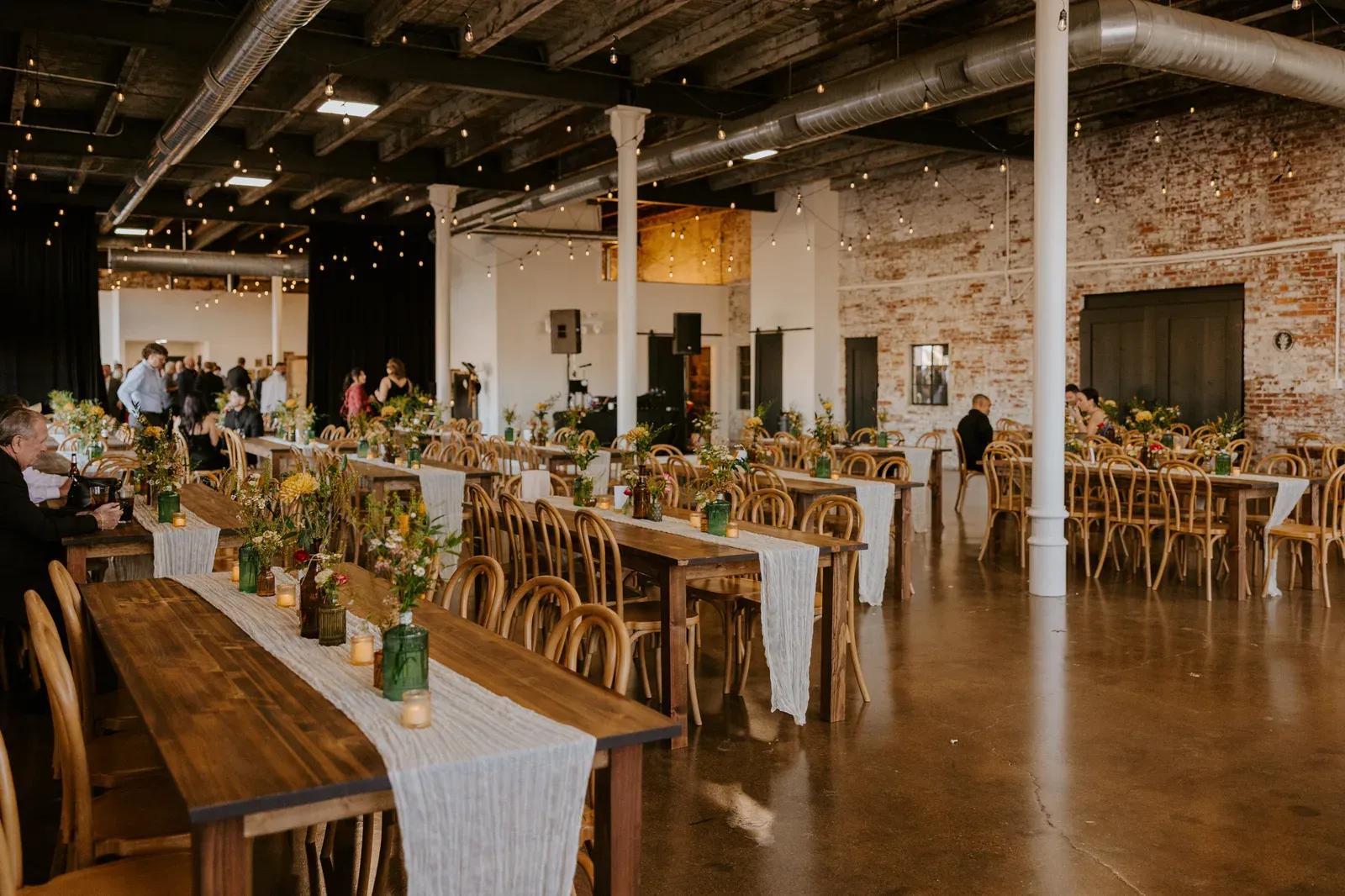
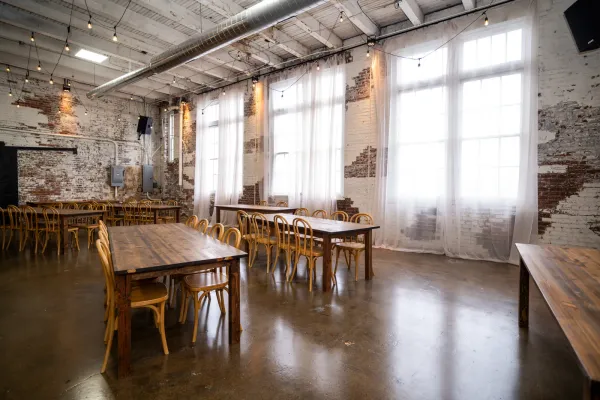
Built in 1898 as the bottling house for the Home Brewing Company, the building at 24 Shelby Street is the only surviving pre-Prohibition brewery structure in Indianapolis. The Edison Room seats 250 guests for a formal banquet under original wood-beam ceilings and Edison string lights, with the Libations Lounge bar carrying the cocktail hour and after-party. Single floor, fully ADA accessible. Outside caterers allowed. In-house bar service is required, which keeps the liquor liability and pour discipline with the venue’s own staff. Veteran-owned. Woman-owned. Full venue facts on the our story page and tour booking on the contact page.
According to Sarah Conrad, Managing Partner at 24 Shelby, “Guests don’t care about 90% of the details people stress over. They care about the energy, the flow, and how long the bar line is. A great banquet hall is the room that makes those three things easy.” That maps directly onto how I built the floor plan.
INDUSTRY (828 Venues)
A 6,800 square foot industrial blank canvas inside a former machine shop, just two blocks from Lucas Oil Stadium. INDUSTRY’s calling card is the 24-hour rental window (10 AM the day of, through 10 AM the next day) and the BYO-vendors policy. Outside caterers and bar packages are allowed. Pet-friendly. No event curfew. The space is white walls and exposed brick, so it transforms with lighting and decor. Best for couples who want to bring their own catering and AV team.
Biltwell Event Center
A 1922 former window-and-door factory near the White River, 25,000 square feet across multiple rooms. Capacity tops out around 600 banquet seated and 1,000 standing in the Grand Hall. Sawtooth-roof factory windows and a preserved bank vault are the architectural calling cards. Catering is in-house only (Hoaglin Fine Caterers). On-site complimentary parking for around 200 cars. Best for 400 to 600-guest weddings or corporate galas where one all-inclusive contract is the priority.
 Photo: Photog Boss
Mavris Arts & Event Center
An 1883 restored warehouse just east of the downtown core, 25,000 square feet across six distinct spaces (Gallery, Speakeasy, 2nd Floor, Loft, Garden, Rooftop). Capacity is 325 seated indoor and 1,200 standing across all floors. Catering is exclusive in-house (no outside food or beverage; cake from a licensed bakery is allowed). Twinkle lights and AV are included. Free guest parking one block north after 5 PM and on weekends. Mavris is the local pick when you want multiple distinct rooms in one venue, which is rare in the Indianapolis market.
 Photo: Photog Boss
Crane Bay Event Center
A modern-industrial space in downtown SW with modular bays that scale from 150-guest intimate dinners to 1,500-guest standing receptions. Capacity is 650 seated and 1,500 standing across four bays plus two patios. Catering is exclusive in-house through Crystal Signature Events. AV, draping, and uplighting are in-house too. Parking is 30 free spots plus a 1,200-space paid lot adjacent to the building. Crane Bay is the consensus pick for 600+ guest weddings and large corporate galas.
The Heirloom at N.K. Hurst
An industrial loft inside the historic N.K. Hurst Bean Company building, just south of downtown near Lucas Oil. Capacity is 325 seated banquet and 800 standing reception across the full space. Catering is exclusive in-house through Crystal Signature Events (the same group that runs Crane Bay catering). The Heirloom’s standout is logistics: 300 complimentary parking spaces (rare for downtown Indy), 25 farm tables and 400 vineyard chairs included, three portable bars, house sound system, and a wireless mic. Best for 250 to 325-guest formal seated events that need turn-key furniture and parking.
VisionLoft Stutz
A 7,300 square foot white-washed historic loft inside the Stutz Automobile Factory in the Stutz district. Capacity is 310 seated and 425 standing. Open catering policy (rare among Indianapolis halls of this size). Ghost chairs and white-washed wood tables are included. Best for couples who want a bright, photo-driven loft and the freedom to bring in their preferred caterer.
McGowan Hall
A 1922 Knights of Columbus hall in the Old Northside, 5,000 square feet across the Grand Hall (400 seated) and Council Room (120 seated). Original maple hardwood floors, sconces, and a stage. Outside caterers permitted. No food and beverage minimums (uncommon for historic halls). Tables and chairs included. McGowan Hall is the local pick for 200 to 400-guest events where flexibility matters more than polish: quinceañeras, retirement parties, fraternal banquets, and budget-conscious wedding receptions.
What Are the Best Hotel Ballrooms in Indianapolis?
Hotel ballrooms trade vendor flexibility for one-contract simplicity and on-site lodging. For 400+ guest weddings with destination guests, or corporate events tied to a convention, they are usually the right call. All five below are downtown and walkable to the Indiana Convention Center.
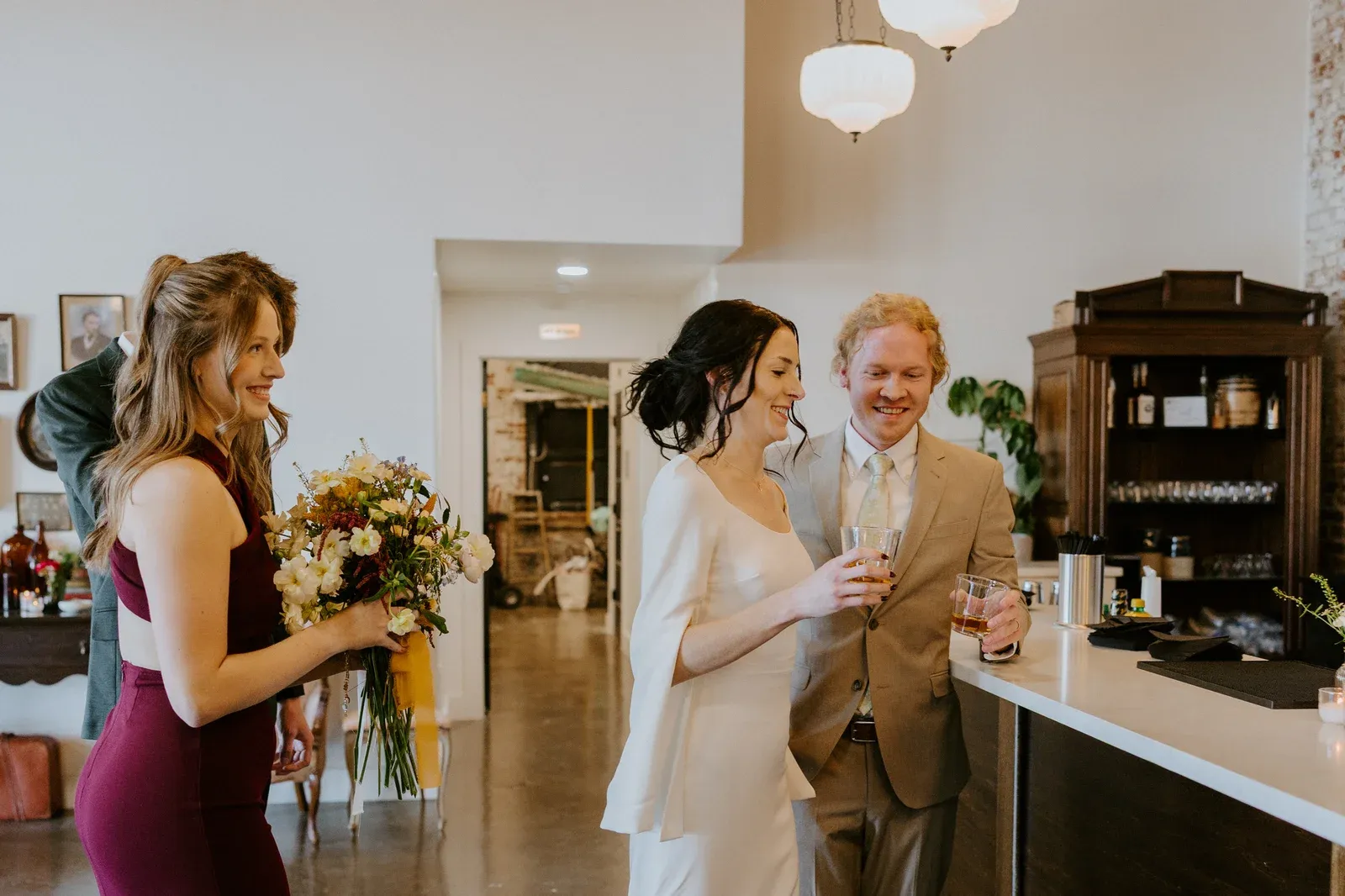 Photo: Clay House Photography
JW Marriott Indianapolis (Grand Ballroom)
The 40,500 square foot JW Grand Ballroom is the largest hotel ballroom in the Midwest, seating 2,750 banquet and 4,200 reception. The smaller White River Ballroom seats 1,450 banquet. Adjacent to the Indiana Convention Center, attached to a 1,005-room hotel. Catering is exclusive in-house. Best for 1,000+ guest galas, conventions, and high-profile corporate events.
Conrad Indianapolis (Vienna Ballroom + Artsgarden)
The Vienna Ballroom is 4,800 square feet, seats 360 banquet and 450 reception, and lives under 18-foot ceilings hung with Preciosa crystal chandeliers (800 faceted crystal balls each). The Artsgarden, the glass-domed pavilion suspended over the Washington and Illinois intersection, is bookable up to 350. Catering is exclusive in-house. Best for elegant 250 to 350-guest seated events with luxury production values.
Hyatt Regency Indianapolis (Regency + Cosmopolitan Ballrooms)
The Regency Ballroom is 9,408 square feet, seats 740 banquet and 1,300 reception. The Cosmopolitan Ballroom is 8,226 square feet, seats 630 banquet and 1,160 reception. The hotel sits under a 21-story atrium and is skywalk-connected to the Convention Center. Catering is exclusive in-house. Best for 600 to 1,300-guest corporate banquets and large ballroom weddings.
Crowne Plaza Indianapolis Downtown Union Station (Grand Hall)
The Grand Hall sits inside America’s first union station (built 1888), under a barrel-vaulted glass ceiling with 3,000+ square feet of original stained glass and 20-foot leaded wagon-wheel windows. Capacity is 320 banquet and 600 reception. Catering is in-house. Twenty-six of the hotel’s rooms are converted Pullman train cars. Best for 250 to 320-guest formal weddings where the room itself is the centerpiece.
Westin Indianapolis (Grand Ballroom)
The Westin Grand Ballroom is the largest of 24 event rooms inside the hotel, with capacity up to 2,000 reception. The secondary Capitol Ballroom holds 790. Connected via skywalk to the Convention Center. Catering is exclusive in-house. Best for mid-to-large corporate events and 400 to 800-guest weddings tied to a downtown hotel block.
How Do I Match a Banquet Hall to My Event Type?
Banquet halls are not wedding-only. Roughly 60% of bookings nationally are non-wedding events (Vivaldi Venues, 2024). The right hall depends on the format.
Wedding receptions (75 to 300 guests). Indianapolis weddings average about 150 guests, so most local couples need a hall sized for 175+ to leave room for dance floor and bar. The historic and industrial halls (24 Shelby, INDUSTRY, Biltwell, Mavris, The Heirloom) are the consensus shortlist. Hotel ballrooms make sense above 300 guests or when half the guest list is flying in.
Corporate dinners and galas (50 to 500 guests). AV is the deciding factor. Hotel ballrooms (Conrad, Hyatt Regency, Westin) are the safe call for product launches, awards dinners, and conventions where reliable production matters. For mid-sized corporate dinners (100 to 300 guests), Mavris, Crane Bay, and The Heirloom give you more aesthetic character and less ballroom feel.
Quinceañeras (100 to 300 guests). Format matters here. The Mass and reception sometimes happen at the same venue, sometimes split. Banquet halls that allow outside catering (McGowan Hall, VisionLoft Stutz, 24 Shelby) tend to be the local pick because the family caterer is part of the tradition. The hall needs a clear stage area for the choreographed dances and a generous dance floor.
Milestone birthdays, retirement parties, anniversaries (50 to 200 guests). Smaller scale, more flexibility on day of week. Friday and Sunday weekday dates are wide open at most Indianapolis halls. McGowan Hall, the Mavris Speakeasy, the 24 Shelby Libations Lounge, and the smaller hotel meeting rooms all work at this scale.
Fundraising galas and nonprofit events (150 to 600 guests). AV and parking dominate. Crane Bay, The Heirloom, Biltwell, and the JW Marriott Grand Ballroom are the local picks. For high-impact branded galas, the Crowne Plaza Union Station Grand Hall reads as photo-worthy as anything in the city.
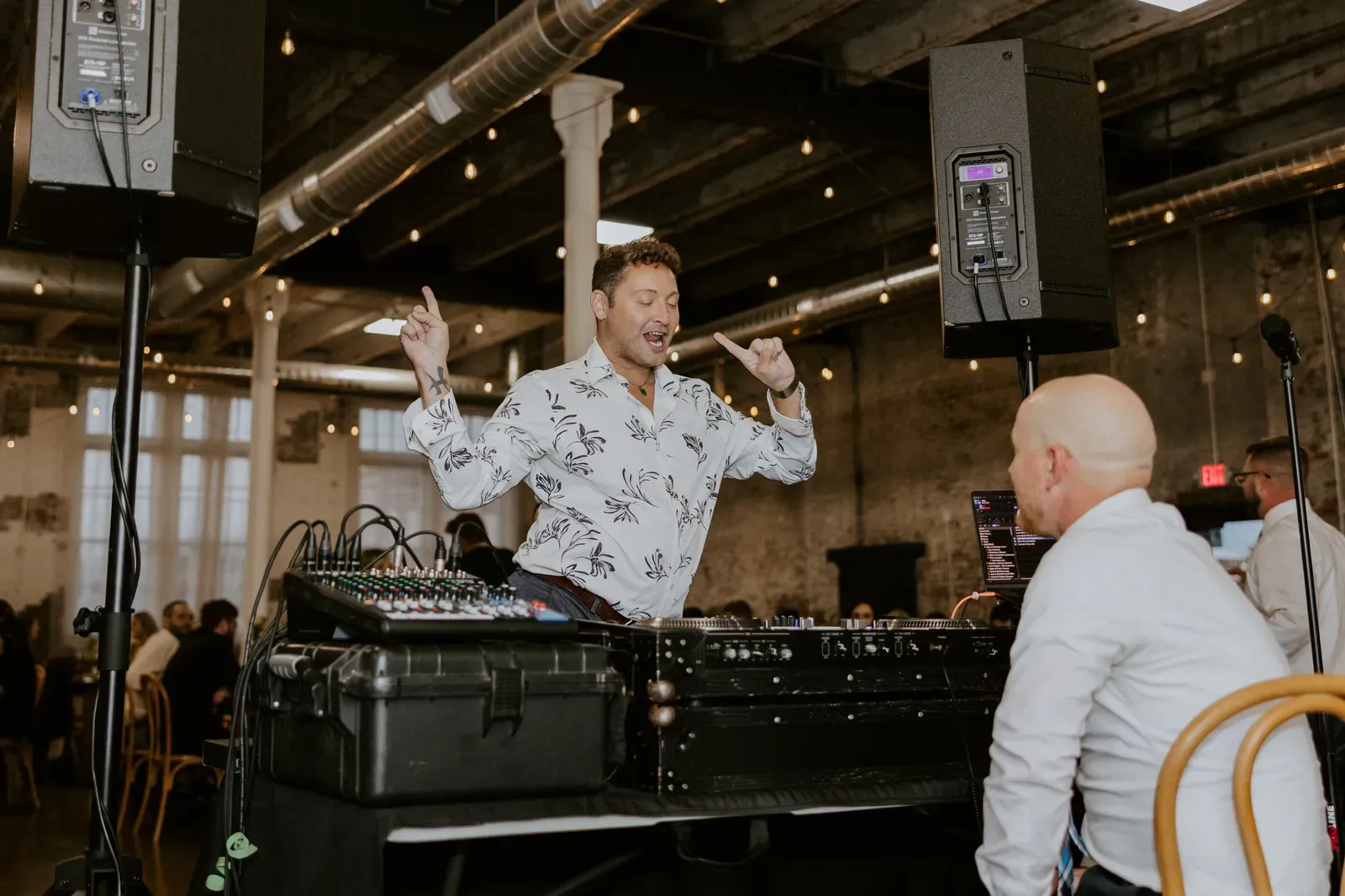 Photo: Photog Boss
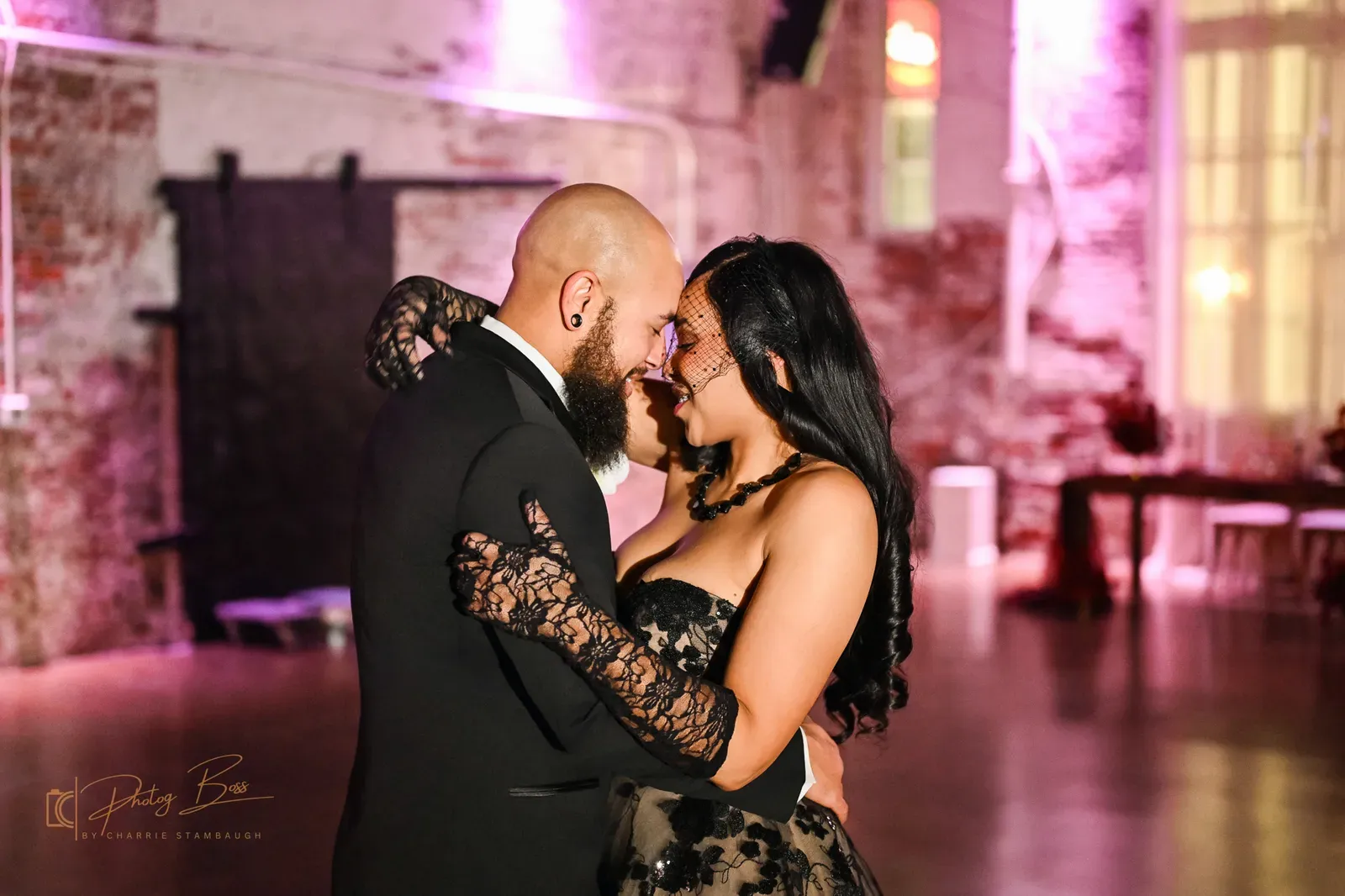 Photo: Photog Boss
How Do I Match a Banquet Hall to My Guest Count?
| Guest count | Best halls |
|---|---|
| 50 to 150 | 24 Shelby Libations Lounge, Mavris Speakeasy, McGowan Hall Council Room, Conrad smaller meeting rooms |
| 150 to 300 | 24 Shelby Edison Room, INDUSTRY, VisionLoft Stutz, McGowan Hall Grand Hall, Crowne Plaza Grand Hall, Conrad Vienna Ballroom |
| 300 to 500 | Mavris main floors, The Heirloom at N.K. Hurst, Crane Bay (smaller bay configurations) |
| 500 to 1,000 | Biltwell Grand Hall, Crane Bay full configuration, Hyatt Regency Cosmopolitan |
| 1,000+ | JW Marriott Grand Ballroom, Hyatt Regency Regency Ballroom, Westin Grand Ballroom |
The Indianapolis weekday and Friday or Sunday market is real. About 22% of all weddings now happen midweek, up from roughly 10% five years ago (MMCG, 2026), and the savings versus a Saturday tend to run 20 to 40%. If your date is flexible, ask about Friday and Sunday rates first. The weekday calendar at most local halls has plenty of inventory inside 6 months.
What Should I Ask on a Banquet Hall Tour?
Five questions are worth more than the rest:
- What’s included in the rental fee? Tables, chairs, linens, setup, breakdown, security, basic AV, dance floor, and event coordination should all be answered with a yes or a price. Get the answer in writing.
- What is the catering and bar policy? Bar and food rules are usually different. Outside caterer allowed but in-house bar required is the most common pattern at Indianapolis halls (this is the 24 Shelby policy).
- What is the load-in and load-out window? Most halls give the wedding party 2 hours before and 1 hour after. Corporate halls vary. Ask before you commit.
- What’s the rain or backup plan? Only relevant for halls with outdoor components, but worth asking.
- What’s the deposit, payment schedule, and cancellation policy? Read the contract. Most halls hold 25 to 50% to lock the date.
For the longer version of this checklist, the 25 questions to ask on an Indianapolis wedding venue tour covers every line item I have ever seen go wrong in a contract.
For a budget-friendlier shortlist, see the affordable Indianapolis wedding venues guide. For a broader take on non-wedding event venues, the downtown Indianapolis event venues guide covers the corporate and special-occasion side in more depth. For the historic-only subset of this list, see the Indianapolis historic wedding venues deep dive.
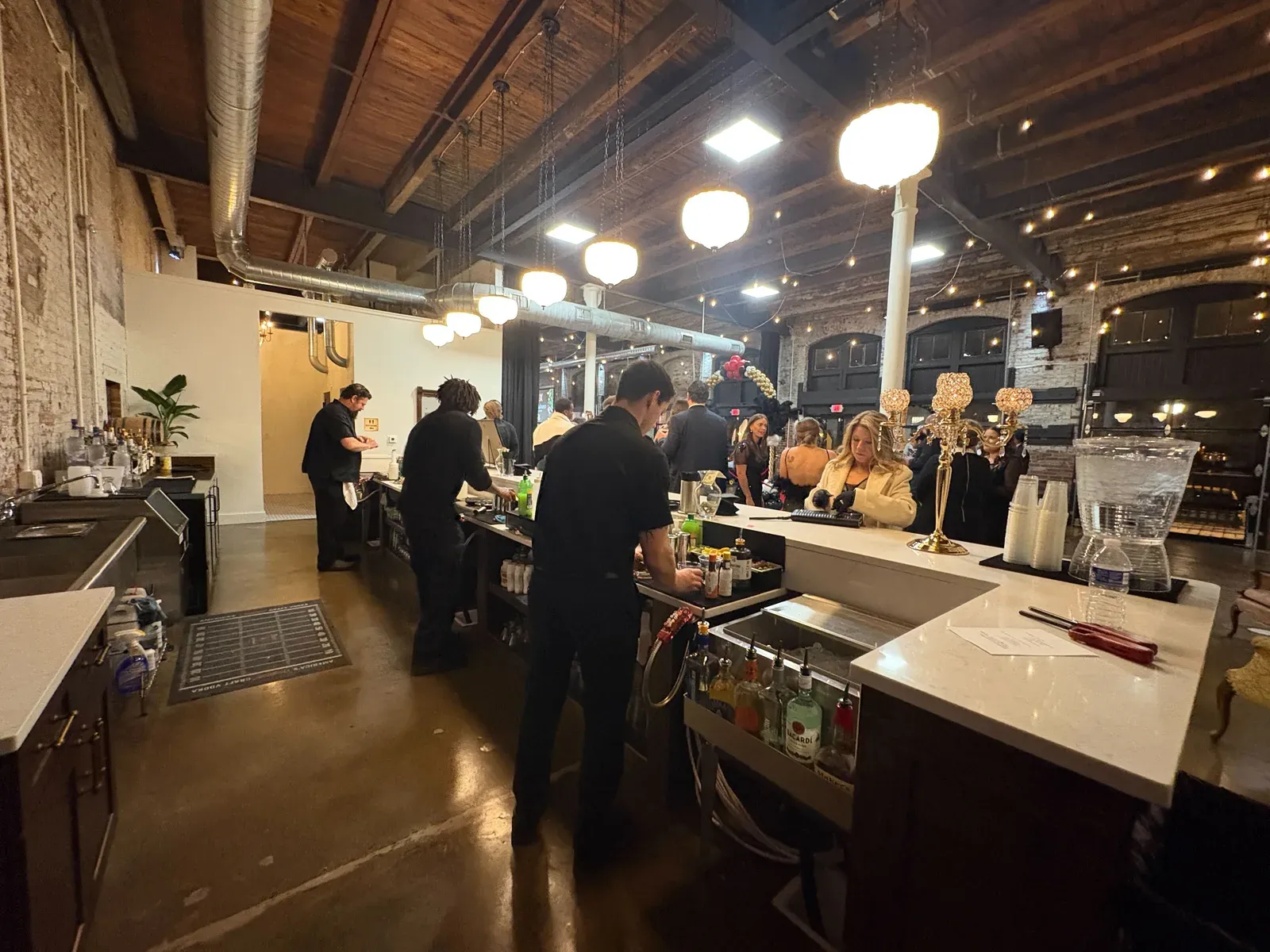 Photo: Photog Boss
When Should I Book a Banquet Hall in Indianapolis?
Saturday wedding dates in September and October book first. October hosts roughly 17% of U.S. weddings, September another 15%, and the September through November stretch accounts for 41% of weddings nationally (The Knot Real Weddings Study, 2026). At downtown Indianapolis halls, peak Saturdays go 12 to 18 months out, sometimes 18 to 24 for the most popular venues.
Corporate holiday parties for November and December book 6 to 9 months ahead. Quinceañeras tend to book 4 to 8 months out. Milestone birthdays, retirement parties, and galas usually book 3 to 6 months ahead. Multi-event weddings (37% of 2026 couples now plan at least one event beyond the ceremony and reception, per the Zola First Look Report, 2026) compound the lead time, since you are booking two or three rooms instead of one.
The takeaway: if your date is fixed and falls in the September through October window, start touring 18 months out. If your date is flexible, lean into Friday, Sunday, and weekday inventory first. The average local couple tours 3 to 5 halls before booking. Build that into the timeline.
The Honest Limitation
I am writing this as the operator of an Indianapolis banquet hall, so the framing here is what I have actually seen work for couples and corporate planners I have hosted. There are smaller community halls, suburban country clubs, and church reception halls in the metro that I have not included here, because they are either bookable only by members or because the sub-300-guest non-wedding market is wide enough that a separate guide makes more sense.
If you are touring 24 Shelby specifically, our downtown Indianapolis wedding venue page has the full venue rundown and a tour-booking form. If you are corporate or a special-occasion host, our Indianapolis corporate event venue and downtown Indianapolis holiday party venue pages cover those setups, or contact us directly. Either way, build the shortlist around capacity and catering policy first. The aesthetic part takes care of itself.
Frequently Asked Questions
What is a banquet hall?
A banquet hall is a purpose-built room or building designed to host large, formal seated events: wedding receptions, corporate dinners, galas, quinceañeras, retirement parties, milestone celebrations, fundraisers, and family reunions. Banquet halls typically include tables, chairs, climate control, AV infrastructure, and either in-house or preferred-list catering, so the rental is closer to turn-key than a raw event space.
What is the difference between a banquet hall and a wedding venue?
A wedding venue is built around the full ceremony plus reception, often with outdoor space, a chapel, or a dedicated ceremony lawn. A banquet hall is built around the formal seated meal and program: plated dinner, speeches, head table, dance floor. The same room can serve both. The search term itself signals the event format more than the building type.
How many guests can an Indianapolis banquet hall hold?
Indianapolis banquet halls range from 200-guest seated capacity at boutique historic rooms to 4,500 reception at the JW Marriott Grand Ballroom. Most local halls land in the 250 to 650 seated range, which fits the average Indianapolis wedding (around 150 guests) and typical corporate dinner (50 to 400). Industry standard is 10 to 15 square feet per seated guest for round-table dining.
Do banquet halls in Indianapolis include catering?
It varies. Hotel ballrooms (JW Marriott, Conrad, Hyatt Regency, Crowne Plaza Union Station) all run exclusive in-house catering. Standalone halls split. Crane Bay, The Heirloom, Mavris, and Biltwell are exclusive in-house. McGowan Hall, INDUSTRY, VisionLoft Stutz, and 24 Shelby allow outside caterers. Confirm both the food policy and the bar policy on every tour, since they are usually separate.
How far in advance should I book a banquet hall in Indianapolis?
Saturday wedding dates in September and October at downtown halls typically book 12 to 18 months out, and the most popular venues book 18 to 24 months out. Corporate holiday parties for November and December book 6 to 9 months ahead. Quinceañeras, milestone birthdays, retirement parties, and galas usually book 3 to 6 months in advance, sometimes faster on weekday dates.
Are banquet halls only for weddings?
No. About 35 to 40% of banquet hall bookings are wedding receptions, but the rest spans corporate galas and holiday parties, quinceañeras, bar and bat mitzvahs, retirement parties, milestone birthdays, anniversary celebrations, fundraising galas, family reunions, and memorial luncheons (Vivaldi Venues, 2024). The 'banquet hall' search term tends to skew more multi-occasion than 'wedding venue.'
What's included in a banquet hall rental in Indianapolis?
Most Indianapolis banquet halls include tables, chairs, basic linens, climate control, setup and breakdown, and at least basic AV. Hotel ballrooms add china, glassware, dance floor, and event staff inside the food and beverage minimum. Standalone halls vary. Always ask for an itemized list of what's included before comparing two halls on rental fee alone.
Do downtown Indianapolis banquet halls have parking?
Most downtown banquet halls direct guests to attached or nearby paid garages. The Heirloom at N.K. Hurst includes 300 complimentary spaces, Biltwell has roughly 200 free on-site spots, and Mavris offers free guest parking after 5 PM and on weekends. Hotel ballrooms have valet plus connected garages. For weddings with out-of-town guests, ask the venue for a recommended garage and a walking-distance map.
Related Reading
Discovery
Indianapolis Wedding Venues That Allow Outside Catering
Which Indianapolis wedding venues actually allow outside catering, verified from each venue's own site. Catering policies, bar rules, kitchens, and licensing.
Discovery
Indoor vs. Outdoor Weddings in Indianapolis: How to Choose
Indoor vs. outdoor wedding venues in Indianapolis, compared by weather risk, decor cost, guest comfort, and rain plan. Written from inside a downtown venue.
Discovery
Unique Wedding Venues in Indianapolis You Haven't Considered
A locally-sourced guide to 12 unique wedding venues in Indianapolis, from a 1898 brewery to museums, a glass dome over downtown, and the Indy 500 Pagoda.