Photo: Photog Boss
Discovery
Industrial Wedding Venues in Indianapolis: 9 Picks With Real Heritage
 By Sarah Conrad Updated Jun 1, 2026
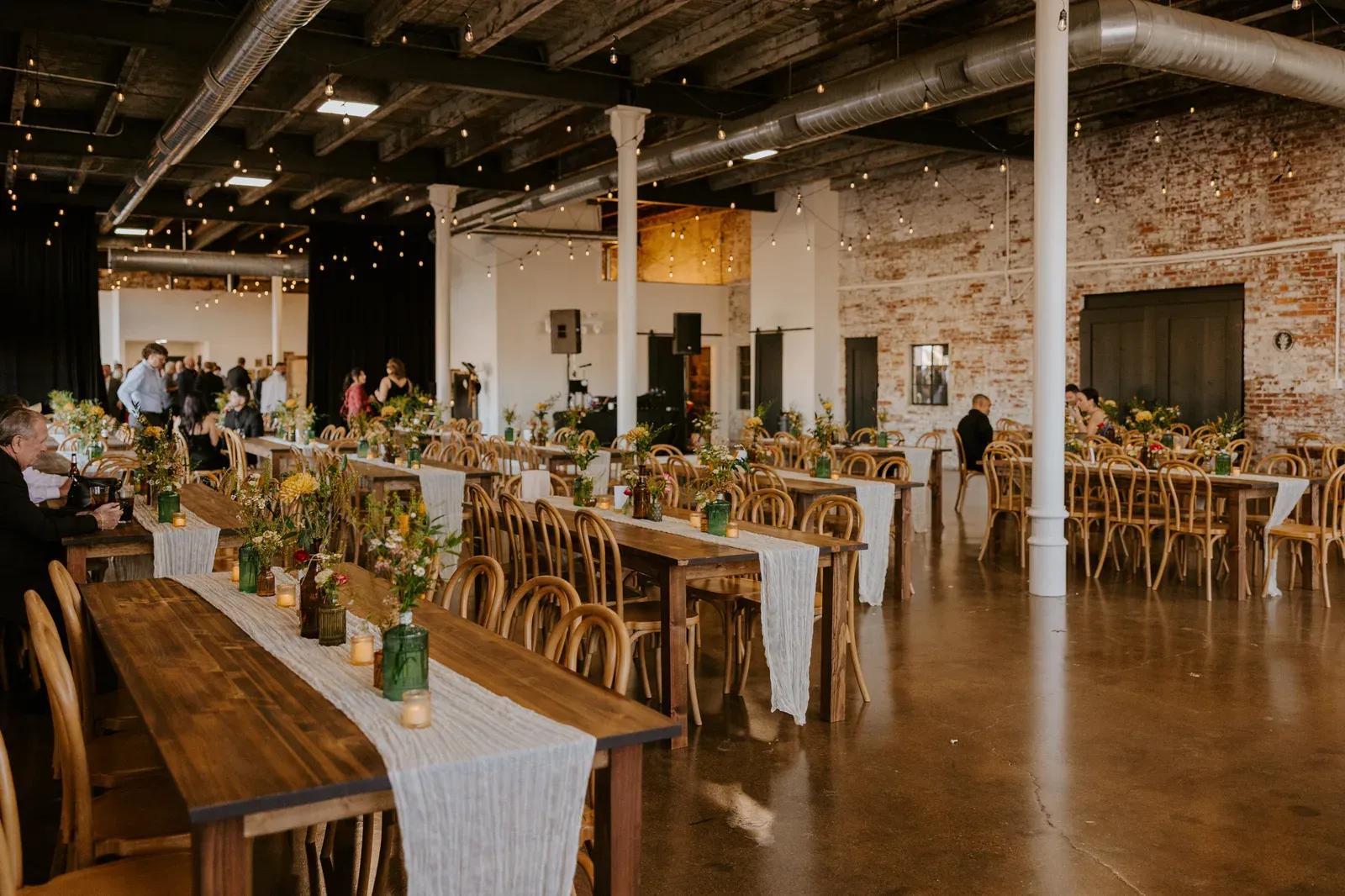
 Indianapolis has nine wedding venues that genuinely qualify as industrial, real factory, mill, and warehouse buildings still standing on their original brick. That includes 24 Shelby in our 1898 bottling house, plus eight others spread across downtown and the suburbs. Here is how they actually compare, what each building used to be, and how to choose between them.
Industrial Chic vs. Industrial With Heritage
Industrial wedding venue is a label that gets stretched. Some venues earn it. Some put a few Edison bulbs over reclaimed wood and call it a day. The distinction matters because what you are actually buying is different.
Industrial chic is the look. Brick walls, exposed beams, concrete floors, big factory windows, soft warm lighting layered over hard surfaces. It can be built inside a brand-new venue and most people cannot tell.
Industrial with heritage is the look plus a real building. The factory was a factory. The mill ground flour. The bottling house bottled beer. The architecture is original because nobody had to fake it.
I run a venue in the second bucket, so I am biased. But the difference shows up on the wedding day in two specific ways: photographs and stories. Industrial-with-heritage venues take a photo that looks like nowhere else in the city because no other venue has those specific walls. And the building gives your guests something to talk about beyond the bride. Both are advantages worth real money in a market where most weddings start to look the same.
The good news: both categories work. The styling tips toward the bottom of this post apply whether you book a 1900s factory or a 2018 build with industrial finishes.
According to Sarah Conrad, Managing Partner at 24 Shelby, “I tore the old bottling house stage apart with my own hands before any renovation started. It took several days of pulling nails out of 1898 wood. After I finished, I could finally see the whole venue. That is what ‘industrial with heritage’ actually means. Somebody did the unglamorous work of preserving the bones.”
Industrial Wedding Venues in Indianapolis at a Glance
The nine venues below are the ones Indianapolis couples shortlist most often when industrial is the lead criterion. Capacities are pulled from each venue’s own site, not third-party listings. Catering policies are confirmed where surfaced; flag any venue you are seriously considering and reconfirm during the tour.
| Venue | Year Built | Original Purpose | Capacity (seated / standing) | Catering | Neighborhood |
|---|---|---|---|---|---|
| Mill Top | 1865 | Kismet Flour mill, then Marmon Motor Car (Indy 500 winner 1911) | ~300 seated | Outside catering allowed (confirm) | Downtown Noblesville |
| Mavris Arts and Event Center | 1883 | Grocery import terminal, later plumbing warehouse | ~300 seated | In-house only | Cole-Noble |
| 24 Shelby | 1898 | Home Brewing Company bottling house | 250 / 300+ | Outside catering allowed; in-house bar | Bates-Hendricks |
| The Heirloom at N.K. Hurst | 1906 | Printing company, then Kroger produce, then N.K. Hurst beans | 350 / 900 | Crystal Signature Events in-house | Downtown SW |
| INDUSTRY (828 Venues) | 1908 | Ball-bearing machine shop | 300+ | BYO vendors fully allowed | Stadium Village |
| Crane Bay Event Center | 1800s, GM-era c.1911 | Potbelly stove factory, then GM train engine parts | 650 / 1,500 | Crystal Signature Events in-house | Downtown SW |
| Tinker House Events | 1915 | Light-industrial Tinker building | 200 / 230 | Confirm with venue | 16th + Monon |
| Biltwell Event Center | 1922 | Window and door factory | ~650 / 350 | In-house only | Near-Westside |
| VisionLoft Mass Ave | Historic (era unspecified on site) | Repurposed downtown commercial | 200 / 250 | Long preferred-caterer list; outside permitted by discussion | Mass Ave |
The full picture, every Indianapolis style and not just industrial, sits in the complete Indianapolis wedding venue guide. Couples shopping the historic angle should also see the historic Indianapolis wedding venues post, since five of the nine industrial venues here also qualify as historic.
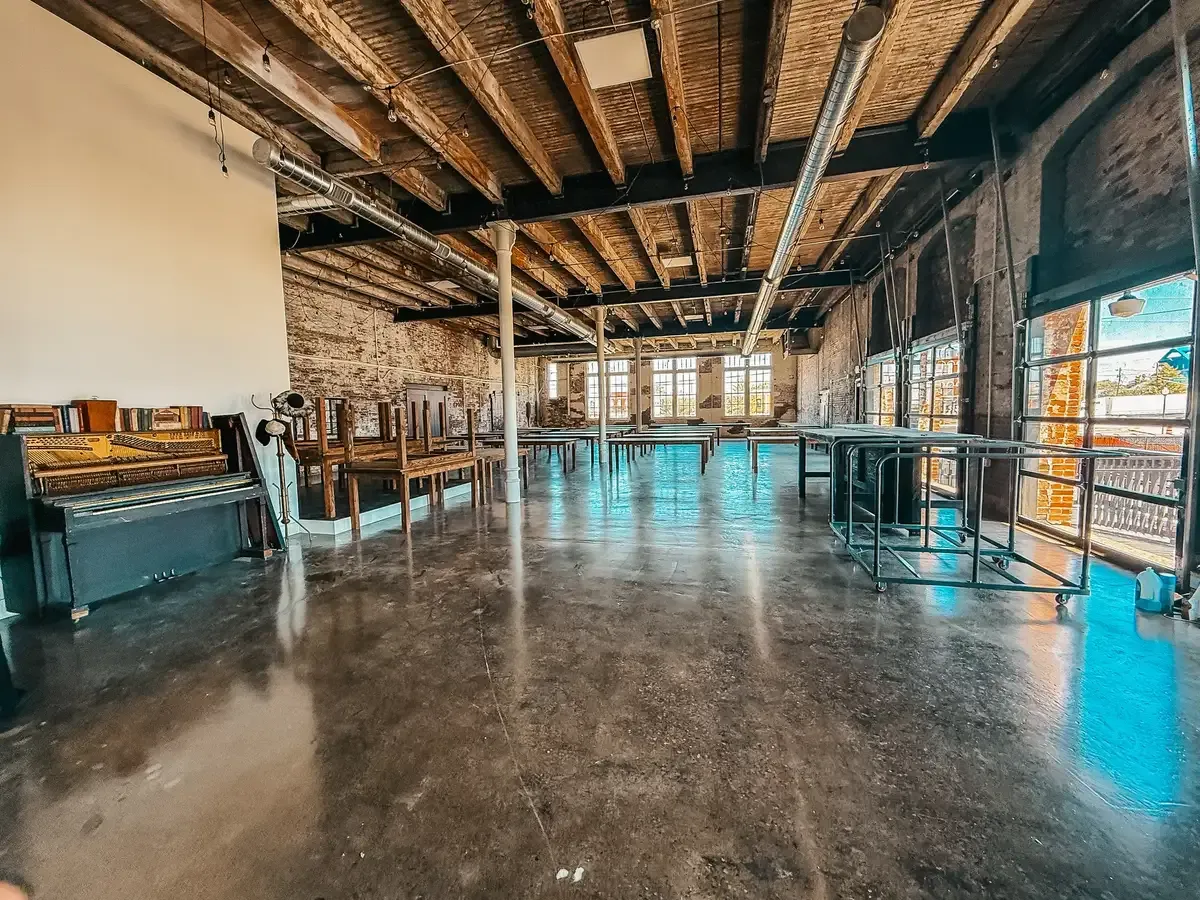 Photo: Photog Boss
What Makes a Wedding Venue Truly “Industrial”?
The honest answer is original materials. A genuinely industrial venue keeps its original brick, beams, columns, concrete floors, and factory windows visible after the renovation. The Knot’s 2026 Real Weddings Study lists industrial-chic venues as one of the year’s top venue trends, and the venue mix has shifted hard against ballrooms (now 20% of receptions) toward unconventional spaces (The Knot, 2026). Read the full study. The Pinterest Predicts 2026 trend report measured a 1,115% spike in searches for “jazz club wedding” and 225% for “speakeasy lounge” (Pinterest, 2026), full trend report here, both of which point at urban, character-rich, brick-and-low-light aesthetics that overlap directly with the industrial bucket.
What that looks like in practice on a venue tour: 12-foot-or-higher ceilings, brick or concrete walls visible from inside, original wood beams or steel columns, oversized windows (factory-style multi-pane is the giveaway), and at least one architectural detail that signals what the building used to be. A freight elevator. A bank vault. An original loading dock door. A smokestack still attached to the roofline.
What does not make a venue industrial: a barn with metal accents, a hotel ballroom with brick wallpaper, or an office park with reclaimed-wood furniture. Real industrial is built that way. Faux industrial reads false in photographs.
The 9 Industrial Wedding Venues in Indianapolis
Listed in order of the original building’s construction, oldest first.
Mill Top Banquet & Conference Center (1865)
The oldest industrial-heritage venue on this list. The original Model Mill ground Kismet Flour starting in 1865, then became the Marmon Motor Car Company in 1899. The Marmon Wasp rolled out of this building and won the very first Indianapolis 500 in 1911. The original smokestack still rises over downtown Noblesville. Multiple event spaces (Great Room, Loft, Ballroom, Skylight Room), original brick walls and arches, wood beams wrapped in twinkle lights, and Indy 500 history baked into the floor plan. Source: milltop-indy.com. It is a 25-minute drive from downtown Indianapolis, so weigh that against your guest list.
Mavris Arts and Event Center (1883)
An 1883 brick building in the Cole-Noble district, originally a grocery-import terminal on the rail line, later a plumbing warehouse. Six event spaces stack: a main hall with original exposed brick, a speakeasy bar, a rooftop, three smaller rooms, and a 199-capacity outdoor lawn. Indoor max is roughly 300 seated. Catering is exclusively in-house, no exceptions for outside food (a licensed dessert vendor is the only carve-out). Source: mavris.net.
24 Shelby (1898)
Our building. Built in 1898 as the bottling house for the Home Brewing Company, the only surviving pre-Prohibition brewery building in Indianapolis. At peak operation in the early 1900s, the bottling house filled up to 60 barrels of beer daily. August Hook served as brewmaster here; his son went on to found Hook’s Drugs, the largest drugstore chain in the Midwest. After Prohibition closed the brewery in 1922, the building served as a steam plant, a power station, a tire factory, and a lumber yard, then a craft brewery in 2013. We renovated the 6,000-square-foot bottling house and opened as a wedding venue in 2025. Original brick walls, exposed wood beams, Edison string lights, modern roll-up garage doors that connect to the Prohibition Patio outside. 250 seated, 300+ standing, single floor, fully ADA accessible. Outside catering allowed; bar service runs in-house. Veteran-owned and woman-owned. The full origin lives on the our story page, and the room-by-room layout is on the spaces page.
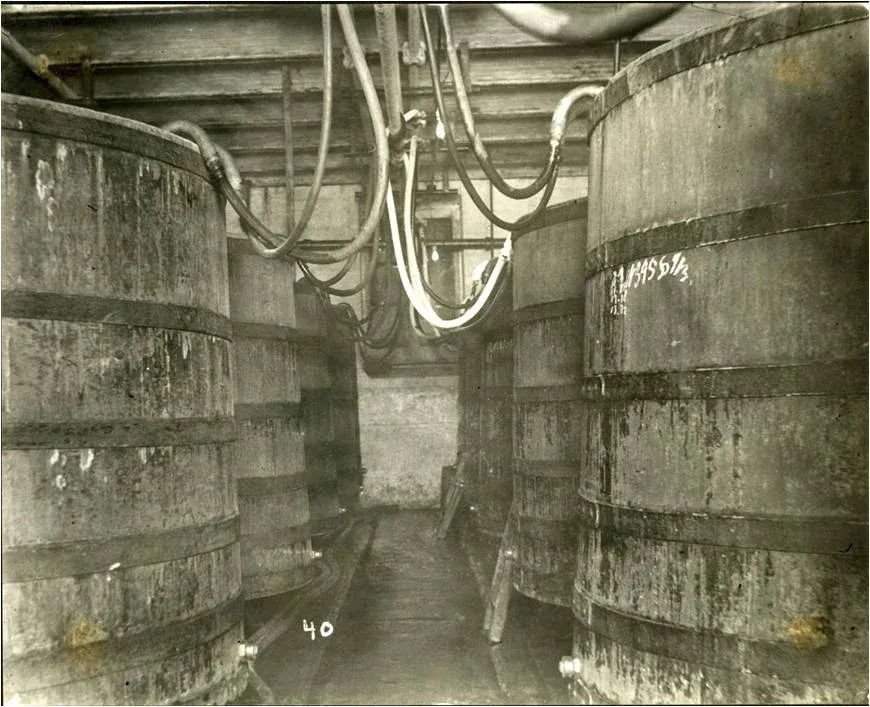 Archival image. Home Brewing Company bottling house, early 1900s.
The Heirloom at N.K. Hurst (1906)
A 1906 building, originally a printing company, then a Kroger produce warehouse, then the N.K. Hurst Co. dried-bean packaging headquarters from 1947 until the company moved out in 2019. Reopened as an event venue starting 2021. 9,000+ square feet, original brick walls, original wood flooring, all-glass garage doors that fully open to an outdoor mezzanine and terrace with skyline views. 350 seated, 900 standing. Catering runs in-house through Crystal Signature Events. The first event ever held there was the Peyton Manning Gala. 300 attached parking spots, which is rare for a downtown venue. Source: theheirloomindy.com.
INDUSTRY (828 Venues) (1908)
A 1908 ball-bearing and metal-fabrication machine shop, renovated in 2014. 6,800 square feet on a single floor in Stadium Village, two blocks from Lucas Oil Stadium. Restored original brick on all five sides, exposed interior beams, redone concrete floors, and wraparound windows for natural light. 300 seated, more for cocktail-style. The differentiator: 24-hour rentals (10am to 10am the next day) and a fully open vendor policy. Couples bring whatever caterer, florist, and DJ they want. Source: industry.828venues.com.
Crane Bay Event Center (c.1900-1911)
The largest industrial-heritage wedding venue in the city. The building started as a potbelly stove factory in the 1800s, then converted to GM train engine parts manufacturing in the early 1900s. 15,000 square feet, modern industrial finishes layered over the original architecture, two private outdoor patios with downtown skyline views. 650 seated, 1,500 standing. 1,200 on-site parking spots, also rare downtown. Catering runs in-house through Crystal Signature Events. Founded by former Indianapolis Colt Gary Padgen. Source: thecranebay.com.
Tinker House Events (1915)
A 1915 light-industrial building on 16th Street near the Monon Trail. Provider Cafe occupies the ground floor; Tinker House sits above it with original timber beams, exposed brick, tall factory windows, and a custom concrete bar wrapped in rope lighting. 200 seated, 230 standing, ~4,000 square feet. Custom installations from local makers (Color Story Studio, Bohall Design) throughout the space. There is a green-room bridal suite styled like an apartment and a veranda balcony with skyline views. 650+ events hosted as of late 2025. Source: tinkerhouseevents.com. Catering policy is not listed publicly; confirm during your tour.
Biltwell Event Center (1922)
A 1922 window and door factory on the near-Westside. 650 seated in the Grand Hall, ~350 in the first-floor space. Original exposed brick, hardwood floors, retractable glass doors to an outdoor patio, antique fire doors throughout, and a preserved bank vault that doubles as a photo backdrop. Edison string lights and a freight elevator. Family-owned by the Sawi family since the venue opened in 2015. In-house catering only, no outside food vendors. Source: biltwelleventcenter.com.
VisionLoft Mass Ave
A repurposed historic building in the Mass Ave Cultural District. The venue site does not specify the original construction year or use, which is unusual for the category and worth asking about on the tour. 200 seated, 250 cocktail. The angle nobody else in the Indy industrial bucket runs: tech. An interactive touch video wall, a digital glassboard guestbook, and remote-guest robotic capability for couples with relatives who cannot travel. Long preferred-caterer list (10+ named); outside caterers permitted by discussion. Source: visionloftevents.com/weddings.
How Do You Style an Industrial Wedding Venue?
The mistake most couples make at industrial venues is fighting the room. Pastel ballroom decor in a brick warehouse looks confused. The fix is to lean in, then soften strategically. Five things actually work:
-
Layer your lighting; do not use one fixture. Layer overhead Edison or market lights for ambient glow, candle clusters on every table for intimacy, professional uplighting on the brick walls (warm tones only, never cool blue), and dimmers on everything. Single-fixture lighting kills industrial photos. Use bulbs in the 2000K to 3500K range; cool/white light above 4000K washes out brick texture and skin tones in photos (Warehouse Lighting, 2024).
-
Get greenery onto the brick. Industrial venues photograph cold without organic texture. Run hanging vine installations or cascading garlands over a head table or a ceremony backdrop. Use brick clips and 150-pound test fishing line to attach weight, never nails or hot glue on painted brick (test on raw brick first). A three-tier mix works: a hardy base like huckleberry or salal for density, a mid layer like spirea for shape, and delicate strands like Italian pittosporum or jasmine for softness (Team Flower, 2024).
-
Soft textiles, hard surfaces. Velvet linens (burgundy, forest, wine) on tables and a velvet sweetheart-table backdrop give the room tactile contrast against brick and concrete. Sheer chiffon or organza overhead softens the ceiling without hiding the beams. Keep heavy fabric for focal areas only (219 Productions, 2024).
-
Pick a palette that works with brick, not against it. Two palettes consistently land in industrial spaces: warm neutrals (ivory, taupe, warm gray) plus metallic accents (copper, gold, matte black); or jewel tones (emerald, sapphire, burgundy, ruby) used as accents over a neutral base. Sage green is the 2026 wedding color of record at 30% adoption and reads beautifully against red brick (Zola, 2026). The full data is in the Zola First Look Report 2026. All-blush or all-pastel schemes feel saccharine in industrial spaces. All-black or all-cool-gray with no warm accent reads sterile.
-
Edit, do not overload. Skip the oversized floral wall, the ten signs at the entrance, and the centerpieces tall enough to block conversation across the table. Couples surveyed by The Knot in 2026 named oversized floral installations as a falling trend, with 29% calling them “out” (The Knot, 2026). Trend report. A clean, edited industrial venue beats a cluttered one in every photograph.
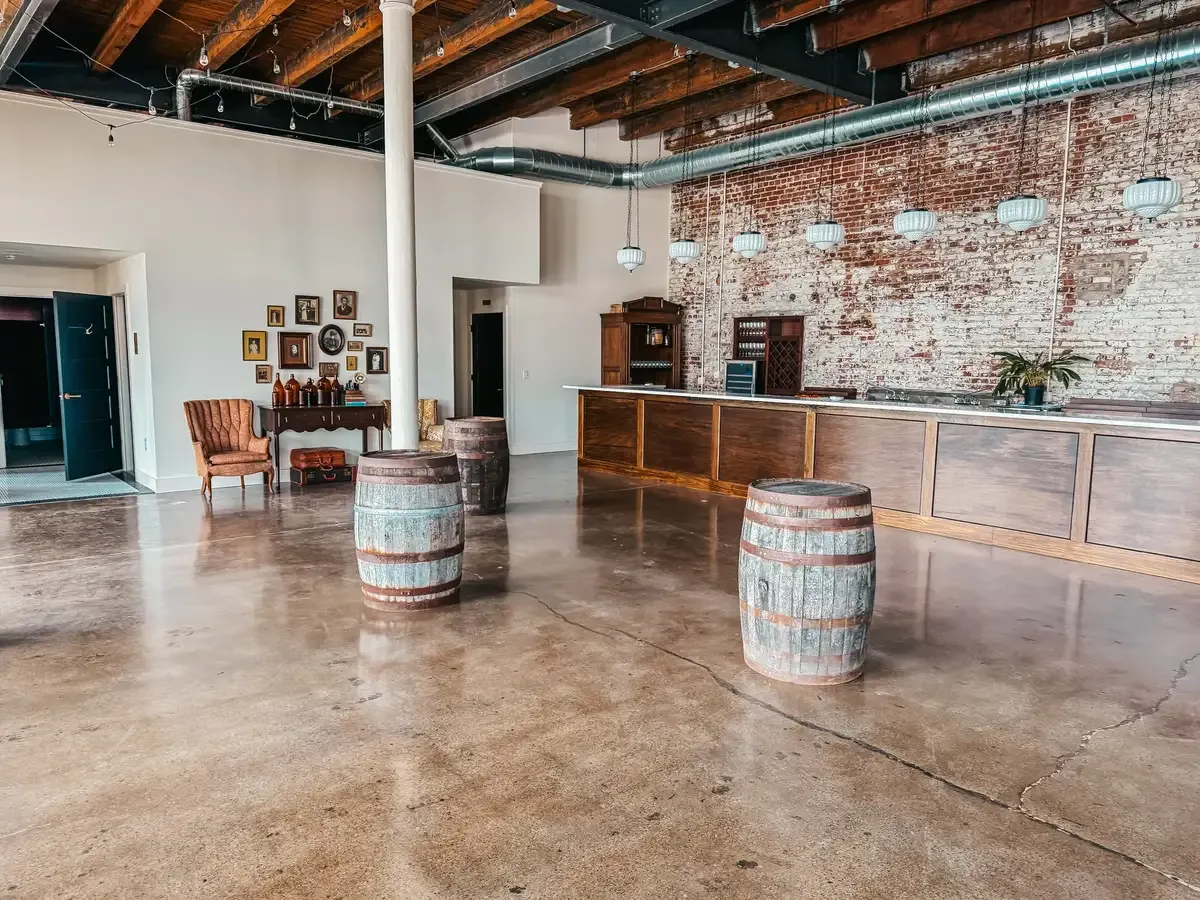 Photo: Photog Boss
What Should You Ask Before Booking an Industrial Indianapolis Venue?
Five questions that catch most couples off guard, specific to industrial-style spaces:
- What is the heating and cooling situation in summer and winter? Industrial buildings with high ceilings, exposed walls, and original windows can run hot in July and cold in February. Confirm HVAC capacity for your guest count and date.
- Where do vendors load in? Original loading docks, freight elevators, and tight stairwells affect what your caterer, florist, and rental company can move. Some venues require vendor walk-throughs in advance.
- What is the noise restriction? Old buildings near residential blocks often have city or landlord-imposed amplified-music cutoffs (10pm or 11pm is common downtown).
- Is the floor original? Original wood flooring affects what shoes are allowed, what dance-floor rentals fit, and what cleaning fees apply if anything spills.
- What is the rain plan? Many industrial venues have outdoor patios or garage-door openings that double as ceremony spaces. Ask what happens at 4pm if it is raining at 6pm.
Indianapolis-metro weddings average 150 to 160 guests, larger than the national average of 117 (The Wedding Report, 2025). Indianapolis market data. That matters at industrial venues specifically, because high-ceilinged warehouse floors that look big in photos feel small once you put 160 chairs in them. Always tour with your real guest count in mind, not the venue’s headline capacity.
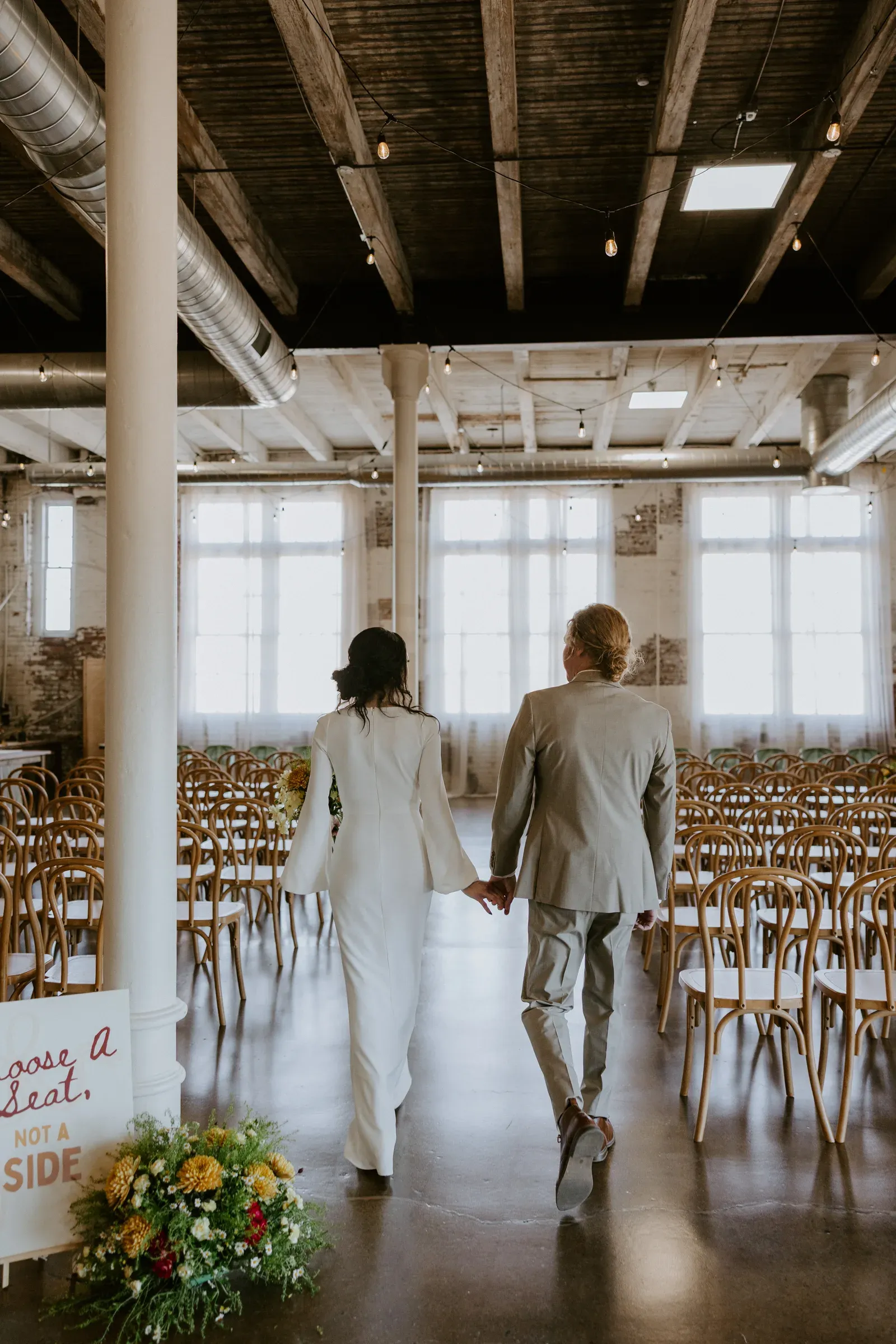 Photo: Clay House Photography
The full downtown Indianapolis event venues guide covers the broader downtown picture, and the small wedding venues in Indianapolis post covers what changes when guest count drops below 100. For couples planning a Roaring Twenties wedding theme, four of the nine industrial venues here fit the era literally. And for couples weighing indoor vs outdoor industrial-style ceremonies, the venues with garage-door openings (24 Shelby, the Heirloom, Biltwell) bridge both options.
If you want to walk our 1898 bottling house specifically, the tour booking page has open Saturdays this month and next, and the room-by-room layout sits on the spaces page.
Frequently Asked Questions
What is the best industrial wedding venue in Indianapolis?
There is no single best industrial wedding venue in Indianapolis. The right one depends on guest count, what's included, and your aesthetic. For 100 to 300 guests with outside catering, 24 Shelby (1898 brewery, downtown), INDUSTRY (1908 machine shop, Stadium Village), and the Heirloom at N.K. Hurst (1906 printing/produce/bean warehouse, downtown SW) lead the shortlist. For 300+ guests, Crane Bay and Biltwell scale highest.
What is the difference between industrial chic and industrial with heritage?
Industrial chic is the aesthetic, exposed brick, beams, concrete, factory windows, warm layered lighting. It can be built into a brand-new venue. Industrial with heritage is that aesthetic plus a real working-industrial building. The factory was a factory. The mill ground flour. The bottling house bottled beer. Heritage venues take photos no other venue can take and give your guests stories to tell.
What is the largest industrial wedding venue in Indianapolis?
Crane Bay Event Center is the largest, at 15,000 square feet with capacity for 650 seated and 1,500 standing. It also has 1,200 on-site parking spots, which is rare downtown. The Heirloom at N.K. Hurst is second at 9,000+ square feet, 350 seated, 900 standing. Biltwell's Grand Hall holds about 650 seated. 24 Shelby's Edison Room holds 250 seated and 300+ standing.
Which Indianapolis industrial wedding venues allow outside catering?
24 Shelby (in-house bar required, but outside food caterers fully allowed) and INDUSTRY (fully open vendor policy, BYO everything) are the two industrial venues with the most catering flexibility. Mill Top historically allows off-premise catering. Biltwell, Mavris, the Heirloom, and Crane Bay all run in-house. VisionLoft Mass Ave maintains a long preferred-caterer list and permits outside vendors by discussion.
What is the difference between a loft, a warehouse, and an industrial wedding venue?
Warehouse describes scale, with vast unobstructed floor plans, 12-foot-plus ceilings, factory windows, and concrete floors. Loft describes a smaller, more refined urban conversion, often multi-story with original wood floors. Industrial is the parent category that includes both, plus mills, factories, machine shops, and bottling houses. In Indianapolis, Crane Bay reads warehouse, Tinker House reads loft, and 24 Shelby sits between the two.
Are there industrial wedding venues outside downtown Indianapolis?
Yes. Mill Top in Noblesville (25 minutes north of downtown) is the oldest, originally an 1865 flour mill that later built the Marmon Wasp that won the first Indianapolis 500 in 1911. INDUSTRY at 545 Kentucky Avenue technically sits in Stadium Village, two blocks south of Lucas Oil Stadium. Tinker House at 16th Street and the Monon Trail is north of the downtown core. Most other industrial venues sit in or adjacent to downtown.
How far in advance do industrial Indianapolis wedding venues book?
Saturday weddings in peak season (May, June, September, October) book 12 to 18 months out at the most-toured industrial venues, including 24 Shelby, Biltwell, Crane Bay, and the Heirloom. Friday and Sunday dates open up 6 to 9 months in advance. The 2026 Indianapolis 500 weekend (May 22-25) and Gen Con (July 30 to August 2) effectively close downtown for weddings since hotels sell out for guest blocks.
Are industrial Indianapolis wedding venues ADA accessible?
Some are, many partially are. 24 Shelby is fully ADA accessible on a single floor. INDUSTRY is single-floor and accessible. Crane Bay and the Heirloom are accessible with elevators. Multi-floor venues like Mavris, Tinker House (above Provider Cafe), and Mill Top often have stairs and original load-in restrictions. Always confirm the wheelchair route from parking to ceremony to reception during the tour.
Related Reading
Discovery
Indianapolis Wedding Venues That Allow Outside Catering
Which Indianapolis wedding venues actually allow outside catering, verified from each venue's own site. Catering policies, bar rules, kitchens, and licensing.
Discovery
Indoor vs. Outdoor Weddings in Indianapolis: How to Choose
Indoor vs. outdoor wedding venues in Indianapolis, compared by weather risk, decor cost, guest comfort, and rain plan. Written from inside a downtown venue.
Discovery
The Best Banquet Halls in Indianapolis (2026 Guide)
12 of the best banquet halls in Indianapolis for wedding receptions, corporate dinners, galas and milestone celebrations. Capacity and catering confirmed.